
March 21, 2023
Solved

Distributions on a final trust return

  • March 21, 2023
  • 2 replies
  • 0 views

I am using TurboTax for Business 2022 to file a final return on a Complex Trust from my deceased parents for benefit of my son.  In 2022 he used the full proceeds of the trust to buy a house.  I am not aware of any special circumstances due to the house purchase.  My question pertains to the topic of the distributions.


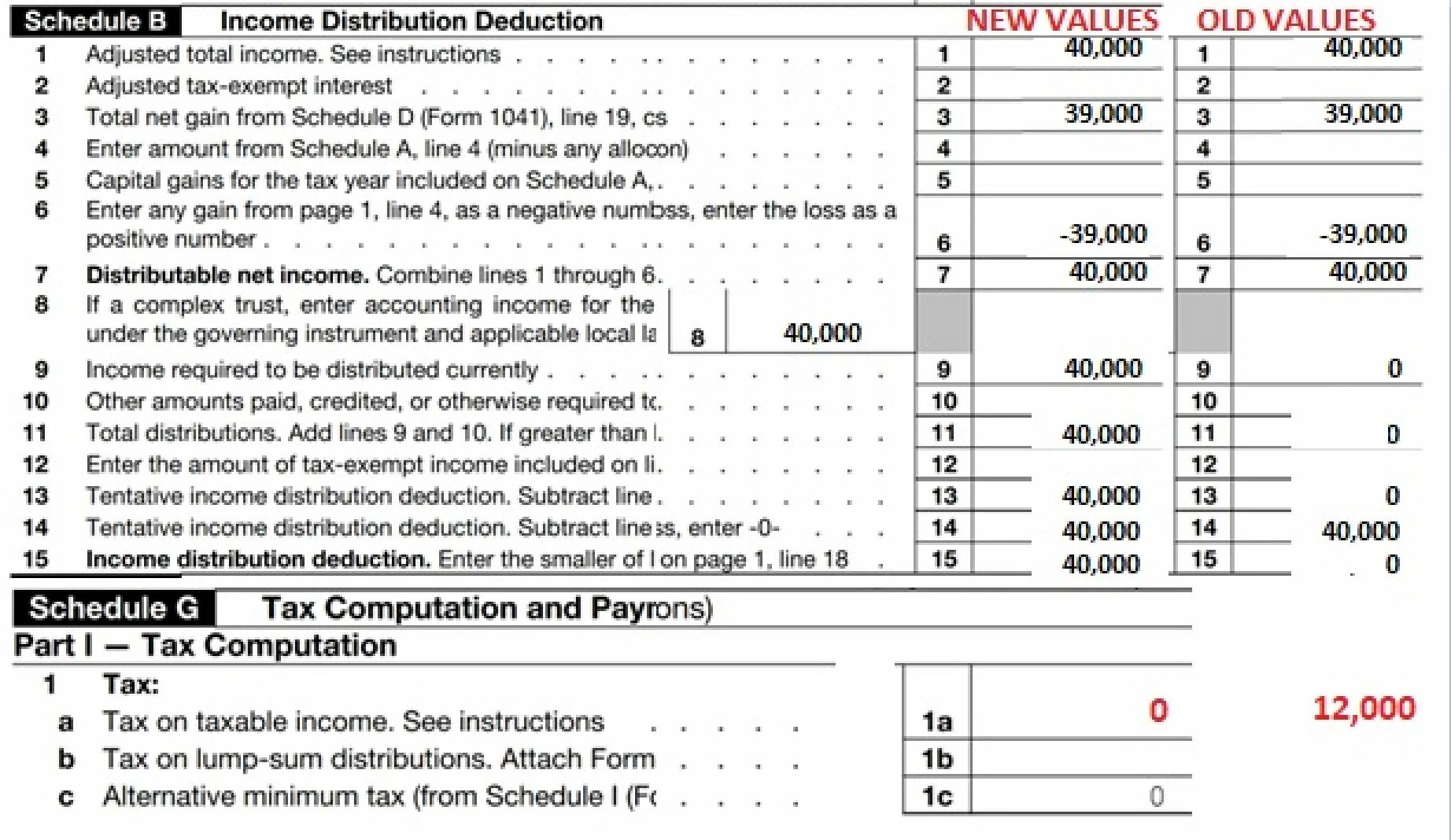
The trust contained long term assets which had large gains on them.  I did the taxes initially by answering No to the question "Did the trust make any distributions to its beneficiaries in 2022".  Since the assets had grown considerably there was approximately 40000 in capital gains which led to a federal income tax of in excess of 12000.  


Going back later to review the return I changed this answer to Yes, since all the money was disbursed 100% to the sole beneficiary.  Everything else on the second return was entered the same.  This one change had a huge impact.  It reduced the tax due to zero! 


The screenshot below shows what I think are the pertainent values.  The New Values column is what happened when I entered Yes for distributions, and the Old Values column is when distributions were set to No.  Since this one change had a large impact, I am looking for some opinions on whether I have entered things correctly or not.  Thanks in advance.
Best answer by ThomasM125

Since all the income was distributed to the beneficiary, it will show up on the schedule K-1 that will be issued to him from the estate. So, he will end up putting the taxable income on his personal tax return and will pay the tax using his personal tax rates, that may well be less than the estate tax rates. So what you describe sounds reasonable.

2 replies

March 21, 2023

Since all the income was distributed to the beneficiary, it will show up on the schedule K-1 that will be issued to him from the estate. So, he will end up putting the taxable income on his personal tax return and will pay the tax using his personal tax rates, that may well be less than the estate tax rates. So what you describe sounds reasonable.

**Say "Thanks" by clicking the thumb icon in a post**Mark the post that answers your question by clicking on "Mark as Best Answer"
March 25, 2023

Thomas:

Glad to hear that I am on track for the federal return.  Any special guidance for the Pennsylvania State return.  Schedule DD is always lacking in guidance so it would be great to get some advice on filling that out.  

Thanks

HopeS
March 27, 2023


See attached Pennsylvania website which provides instructions on Estates and Trusts. 


Once you open the link, click on PA-41 Schedule DD on the right.


PA Department of Revenue Trusts 


@brakeshoe87 

**Say "Thanks" by clicking the thumb icon in a post**Mark the post that answers your question by clicking on "Mark as Best Answer"
March 28, 2023

Link didn't work, but I assume it was just to the PA 41 Schedule DD instructions which I have seen.  The wording there is somewhat difficult to understand.  Lines 8 and 9 are somewhat mystifying.  This trust has no required distributions, but the entire trust was liquidated.  Not sure how to reflect the complete liquidation on Schedule DD.

DaveF1006
March 28, 2023

If an estate or trust has no distributions or is not distributing its income, the estate or trust is not required to complete PA-. 41 Schedule DD per PA 41 Schedule DD instructions. This applies to trust liquidations that has no distributions or income to distribute. 

@brakeshoe87 
 

**Say "Thanks" by clicking the thumb icon in a post**Mark the post that answers your question by clicking on "Mark as Best Answer"




