
March 18, 2024
Solved

Potential Typo - How to carry back the excess foreign tax credit

  • March 18, 2024
  • 1 reply
  • 0 views

Hi all,

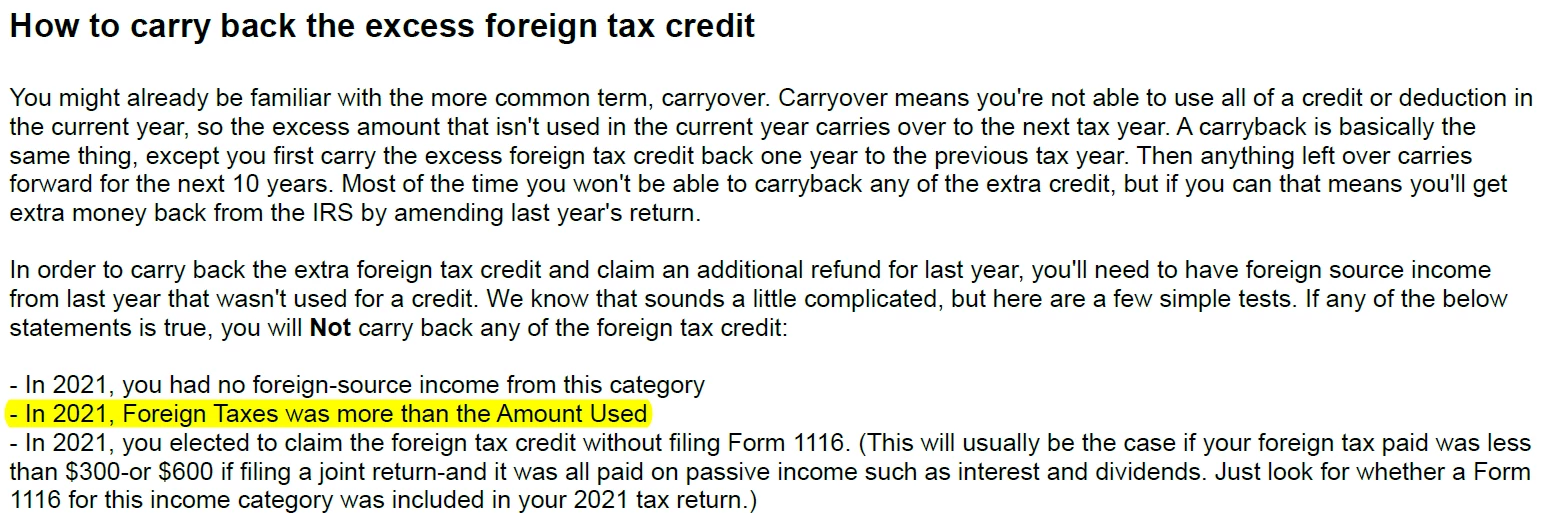
In reviewing the below help center article entitled, "How to carry back the excess foreign tax credit," I'm struggling to make sense of one of the scenarios in which you are not allowed to carry back excess foreign tax credit. Specifically:


"If any of the below statements is true, you will Not carry back any of the foreign tax credit:
...
- In [previous year], Foreign Taxes was more than the Amount Used"


Why would you not be allowed to carry back excess foreign taxes credit to a previous year if - in that previous year - you paid more foreign taxes (e.g., you paid $1,000) than you used (e.g., you only used $100)? If anything, I imagine it would be the opposite way around (i.e., using my example numbers, I can see you not being allowed to carry back if you used $1,000 but only paid $100 in the previous year). Can anyone (e.g., @DaveF1006 ) clarify / confirm or deny whether this is a typo?


Thanks!
 

Best answer by DawnC

Not a typo.  The highlighted statement is referring to the amount of foreign sourced income used.   In order to carry back the credit, you have to have foreign sourced income that was not used.   See this example in Pub 514.   To carry a credit forward or back to a tax year, in that tax year, your tax paid had to be less than the LIMIT for that year, which is based on your foreign income.  


If, because of the limit on the credit, you cannot use the full amount of qualified foreign taxes paid or accrued in the tax year, you are allowed a 1-year carryback and then a 10-year carryover of the unused foreign taxes.     


If the foreign taxes paid were more than the amount used (the highlighted statement), you would have an excess to apply to another year.   You could not apply an excess from another year to a year you already have an excess in.  

1 reply

DawnC
DawnCAnswer
Employee
March 18, 2024

Not a typo.  The highlighted statement is referring to the amount of foreign sourced income used.   In order to carry back the credit, you have to have foreign sourced income that was not used.   See this example in Pub 514.   To carry a credit forward or back to a tax year, in that tax year, your tax paid had to be less than the LIMIT for that year, which is based on your foreign income.  


If, because of the limit on the credit, you cannot use the full amount of qualified foreign taxes paid or accrued in the tax year, you are allowed a 1-year carryback and then a 10-year carryover of the unused foreign taxes.     


If the foreign taxes paid were more than the amount used (the highlighted statement), you would have an excess to apply to another year.   You could not apply an excess from another year to a year you already have an excess in.  

**Say "Thanks" by clicking the thumb icon in a post**Mark the post that answers your question by clicking on "Mark as Best Answer"
skyfxAuthor
March 18, 2024

@DawnC - got it. You can't carry back a credit to a previous year if you already had an excess in that year. Thank you for clarifying.


On a related note - TT has a question related to carryback adjustments (see screenshot below). Under what circumstances would you need to adjust your carryback?


SusanY1
March 18, 2024

Some reasons you may need to make adjustments include: for carrybacks eligible to be used and not taken due to failure to timely file; if the reported foreign income has been reclassified (especially to 951A income) or a refund has been issued for taxes paid; or if you need to allocate the carryback among spouses no longer filing a joint return.  

**Say "Thanks" by clicking the thumb icon in a post**Mark the post that answers your question by clicking on "Mark as Best Answer"




