
February 21, 2021
Question

How to Qualify for American Opportunity Credit

  • February 21, 2021
  • 1 reply
  • 0 views

How to Qualify for American Opportunity if my Scholarships Exceed Tuition

@Hal_Al  Can you please help me?
I had a question regarding American Opportunity Credit. Last year, my scholarship (Box 5) on form 1098-T was greater than the expenses in Box-1. So my parents claimed the American Opportunity Credit on their tax return, however the difference between the scholarship and expenses I put as income on my tax return. 
Can this scenario be applied to my 2021 Tax return. 
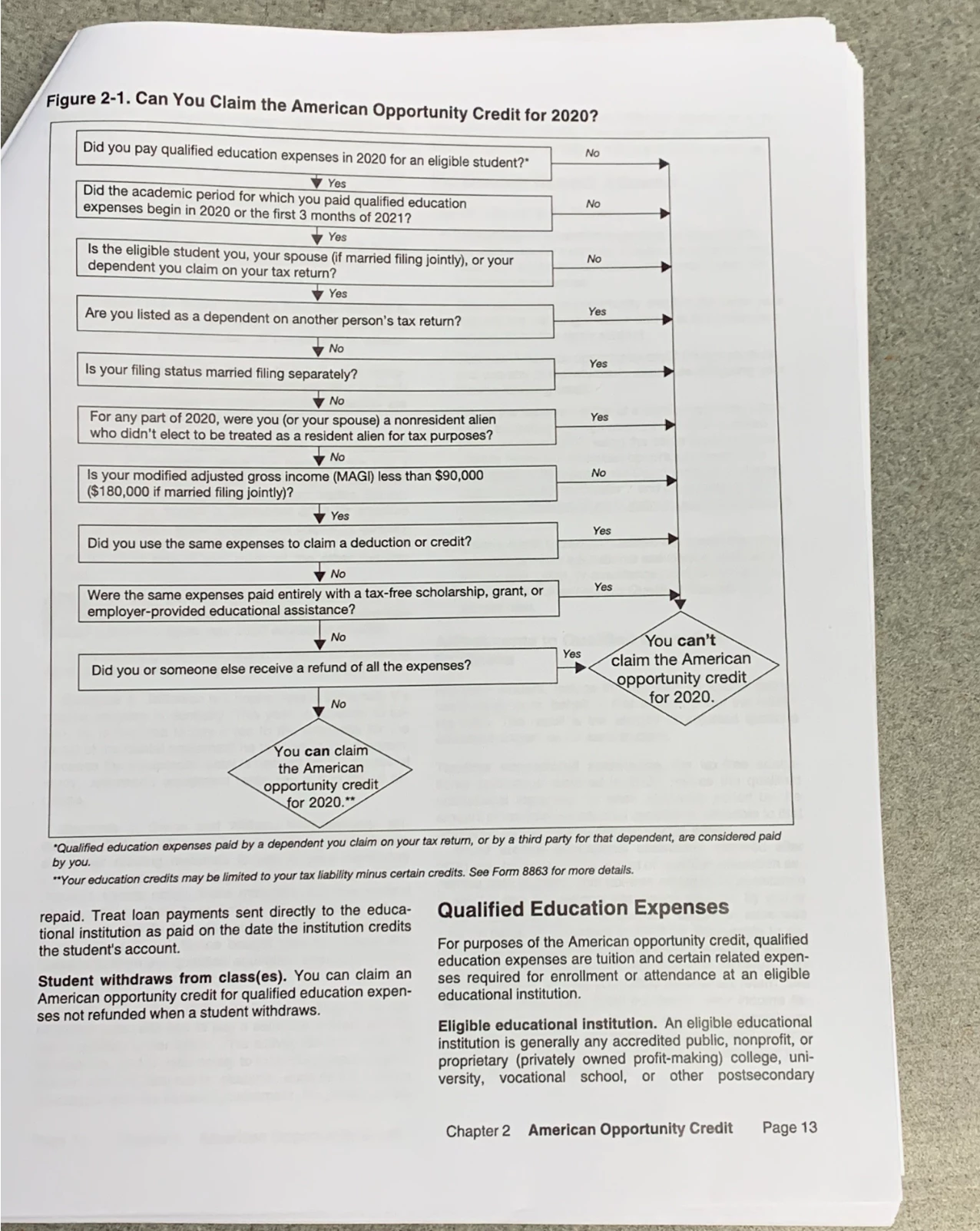
Does the last Scenario in the attached file for American Opportunity Credit mean I do not qualify?
I have seen from previous years that the scenario I described above is in fact a "Tax Loophole". Can I repeat this for my 2021 tax return or has the Loophole been fixed.
I currently meet all the other requirements such as:
 
1) Full-time Student (20 years old)
2) First degree
3) Parents make less than $180,000
4) No prior convictions 
5) I am claimed as a dependent on my parent's Tax return.  
 
Thank You.
    1 reply

    Hal_Al
    Employee
    February 21, 2021

    @dguirgis  said "Last year, my scholarship (Box 5) on form 1098-T was greater than the expenses in Box-1. So my parents claimed the American Opportunity Credit on their tax return, however the difference between the scholarship and expenses I put as income on my tax return. 

     You should have reported the difference plus the $4000 your parents used to claim the credit, as income on your return.  You will do the same thing this year.  See my standard explanation below.  So, yes this scenario can be used in 2021 for your 2020 return. The loop hole has not been close.


    The simple  way to add the $4000: say the scholarship paid for room & board, in the interview. Enter $4000 as the amount.  If you did not add the $4000 in 2019, and it makes a difference in the amount of tax owed  (for most students it doesn't), you will need to file an amended 2019 return.


    Q. Does the last Scenario in the flow chart for American Opportunity Credit mean I do not qualify?

    A. No. The same expenses were not paid by tax free scholarship because you have converted the tax free scholarship to taxable scholarship.

    _____________________________________________________________________________________

    There is a tax “loophole” available. The student reports all his scholarship, up to the amount needed to claim the American opportunity credit, as income on his return. That way, the parents  (or himself, if he is not a dependent) can claim the tuition credit on their return. They can do this because that much tuition was no longer paid by "tax free" scholarship.  You cannot do this if the school’s billing statement specifically shows the scholarships being applied to tuition or if the conditions of the grant are that it be used to pay for qualified expenses.

    Using an example: Student has $10,000 in box 5 of the 1098-T and $8000 in box 1. At first glance he/she has $2000 of taxable income and nobody can claim the American opportunity credit. But if she reports $6000 as income on her return, the parents can claim $4000 of qualified expenses on their return.


    This is not some sinister scheme. From the 2019 form 1040 instructions (pg 95): “You may be able to increase an education credit if the student chooses to include all or part of a Pell grant or certain other scholarships or fellowships in income. For more information, see Pub. 970, the instructions for Form 1040, line 18c, and IRS.gov/EdCredit.  Page 16 of PUB 970 (2019) actually has examples of how to do the “loop hole

    dguirgisAuthor
    February 21, 2021

    Thank you @Hal_Al I appreciate your response. That is exactly what I did for 2020 (adding the $4000 to the difference and claiming it as income while my parents claim the credit).




