
February 21, 2021
Question

How to Qualify for American Opportunity if my Scholarships Exceed Tuition

  • February 21, 2021
  • 1 reply
  • 0 views
I had a question regarding American Opportunity Credit. Last year, my scholarship (Box 5) on form 1098-T was greater than the expenses in Box-1. So my parents claimed the American Opportunity Credit on their tax return, however the difference between the scholarship and expenses I put as income on my tax return. 
Can this scenario be applied to my 2021 Tax return. 
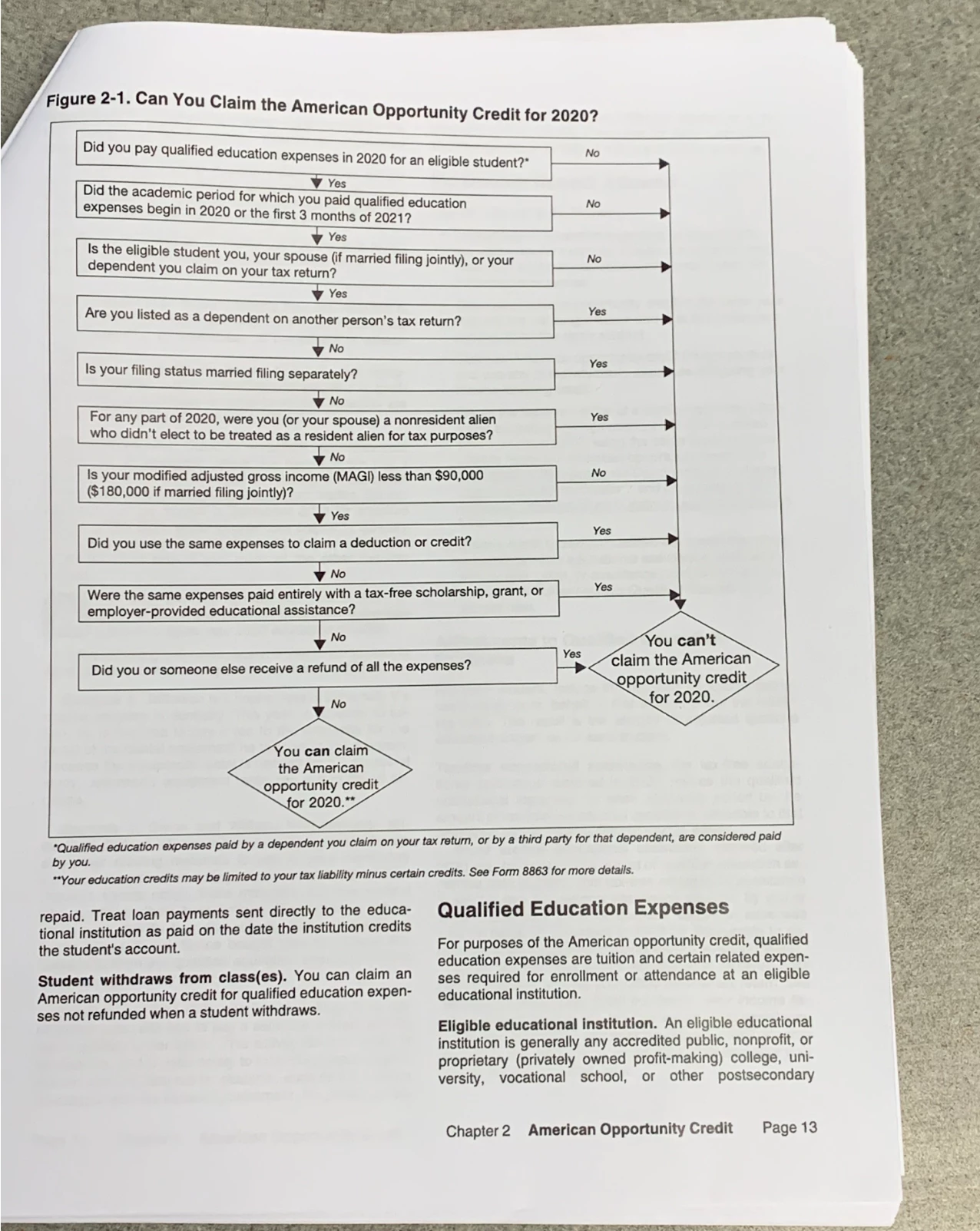
Does the last Scenario in the attached file for American Opportunity Credit mean I do not qualify?
I have seen from previous years that the scenario I described above is in fact a "Tax Loophole". Can I repeat this for my 2021 tax return or has the Loophole been fixed.
I currently meet all the other requirements such as:
 
1) Full-time Student (20 years old)
2) First degree
3) Parents make less than $180,000
4) No prior convictions 
5) I am claimed as a dependent on my parent's Tax return.  
 
Thank You.
 

    1 reply

    hbl3973
    Employee
    February 28, 2021

    dguirgis,

    I'm not sure whether you specifically wanted Hal_Al to reply, but putting a link in the query does not send him a message.  However, I can provide guidance here.


    First, your parents may well have claimed the AOC in 2019 incorrectly if what you state is accurate.  If the scholarship listed in Box 5 exceeds the qualified expenses in Box 1 and the difference was claimed as income on your own tax return, then the qualified expenses in Box 1 are considered paid by the scholarship and not by you or your parents.  There is an exception detailed in the IRS Publication 970 you are showing if the scholarship was specifically designated to pay only room and board.


    It may have been possible to get the 2019 AOC if the scholarship was not strictly limited to tuition and related qualified educational expenses.  This is detailed in the "Coordination with Pell Grants" portion.  In that setting, you add the amount of the qualified expenses to your taxable scholarship income, thereby removing those expenses from having been paid by the scholarship.


    So, unless you and your parents did actually play that income shift card, your parents, and possibly you, should amend the 2019 tax return(s).


    The same set of options and restrictions apply to your and your parents 2020 tax return.


    Also, a final heads up: if the unearned income that you, the dependent student, has exceeds $2,100, then the excess is taxed at your parents rate via IRS form 8615 (https://www.irs.gov/forms-pubs/about-form-8615), the so-called Kiddie Tax.  In some states, such as California, a corresponding tax is assessed as well.




