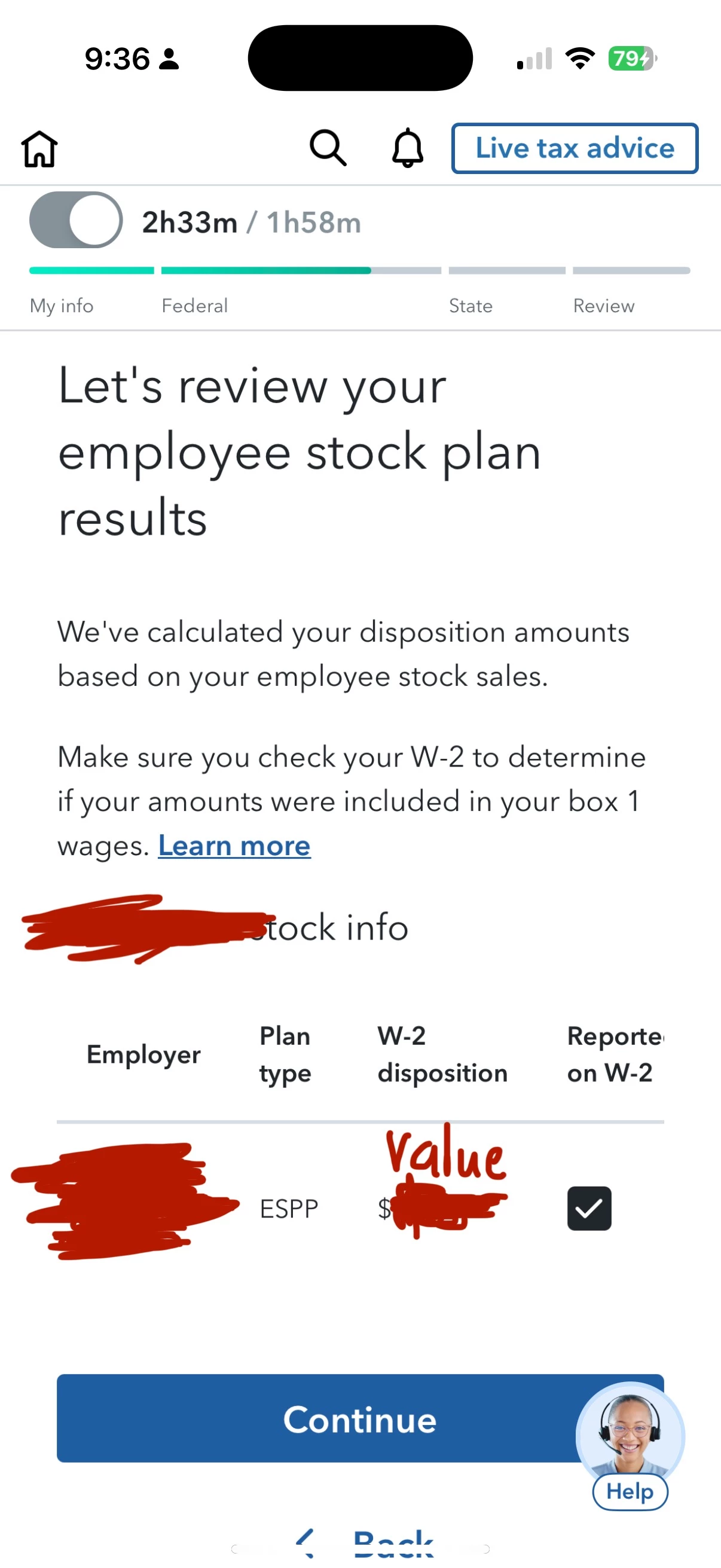
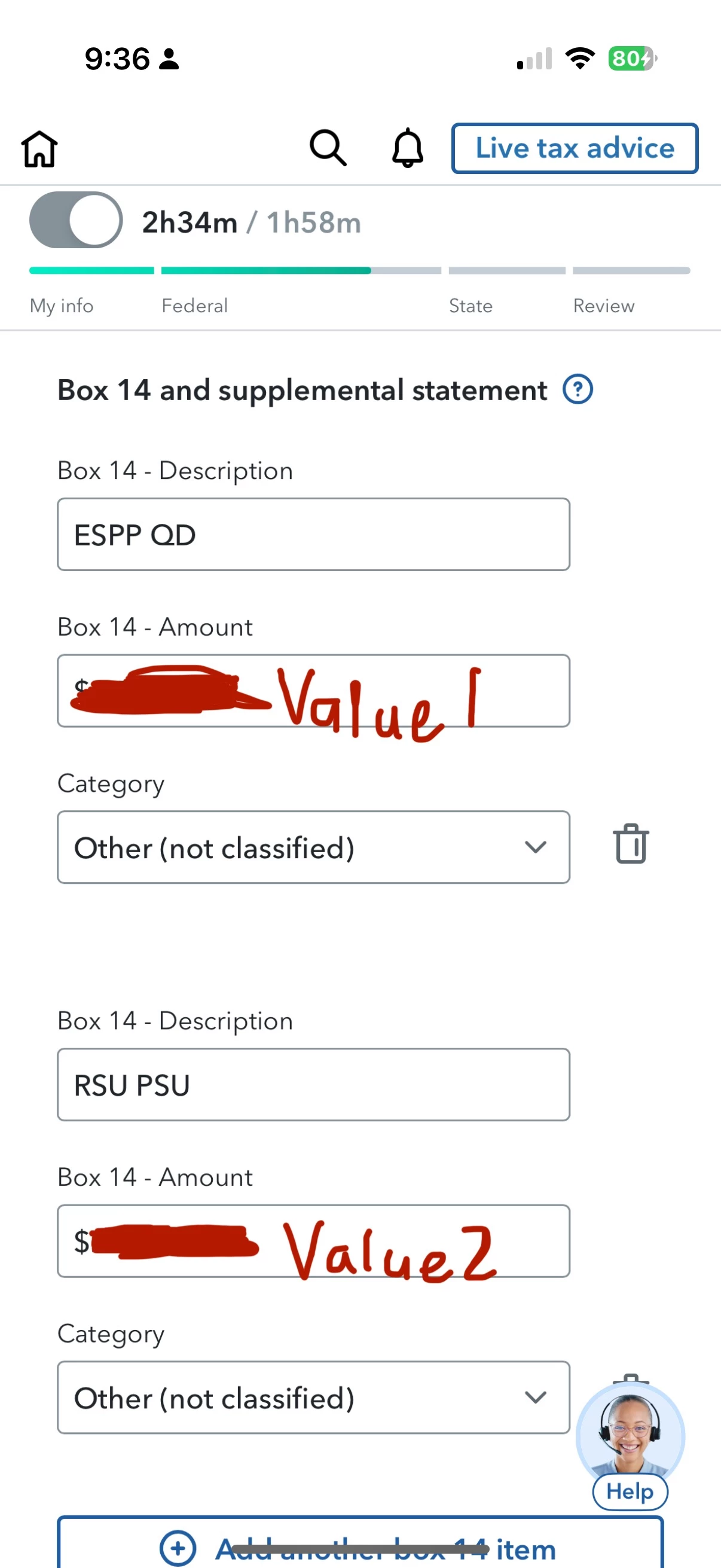
I am honestly very confused. It sounds like I kinda understand how to handle RSUs. For ESPP, discount may be reported as income the year you get them. Not the year you sell them? (That income is reported by brokerage- without adjusting cost basis for discount - and is where double taxing can come in) If they are held long enough they are treated as capital gains - so you can’t adjust the cost basis for discount as income?
So for example, one of my transactions was the sale of an ESPP from 2017 (half of the RSUs I got that year) on my 2017 W2 the only thing listed in box 14 is RS-STK (and the amount) this is different from what was on my 2023 (ESPP QD) and 2022 (no espp listed, only RSU PSU) W2s (the other applicable W2s for ESPP sales this year). I’m not sure how to handle RS-STK. I’m not sure what procedure I would need to do for each of the 3 ESPP sales for this year.
It doesn’t make sense it counts toward income one year when I acquire them and not count toward income the next? Apologies that I don’t understand
Your employee stock discount counts as ordinary income in the year you exercise (purchase) your shares, on your W-2.
It counts as Capital Gain in the year you sell them, reported on a 1099-B. But since the broker doesn't know what you paid for your shares when purchased, the Cost Basis is often incorrect on the 1099-B.
To find the correct cost basis, you need to know what your discount amount was (from W-2), and divide that by number of shares purchased. Add that amount to the Exercise Price per share, to arrive at Cost Basis per share for reporting the 1099-B sale. The Exercise Price is reported on Form 3922 or 3924.
For RSU's you may have paid nothing for your shares. Divide the amount on your W-2 by number of shares, and that's your Cost Basis. Yes, this is a bit different than calculating cost basis for ESPP shares.
Otherwise, you will be overstating your Capital Gains. Once you know your Cost Basis, enter in TurboTax as a regular stock sale (not employee stock).
Here's more info on Employee Stock Purchase Plans and RSU's and Taxes which will help clarify this for you.
@BenTen