
March 27, 2024
Solved

Excess HSA Employer Contribution With Closed HSA Account

  • March 27, 2024
  • 1 reply
  • 0 views

Background. On my wife's W2 for 2022 there's $358 "W" employer HSA contribution in box 12. Of them $54 were in excess. That excess wasn't withdrawn yet. Back then my wife had 2 HSA accounts (one with no contributions in 2022 from previous employer). After marring in January 2022, my wife wasn't eligible for HSA anymore, and moved from high deductible to shared deductible health plan. So excess contribution happened in Jan 2022. In 2023 funds in the HSA account that got excess contributions ran out because of service fees every month, and account got closed. 1099-SA wasn't provided for 2023 for that HSA account since there were no contributions, or distributions, only service fees. Another HSA account from previous employer is still open with >$54, and 1099-SA was provided for it (I think because of distributions).


Problem. When filing taxes for 2023, Turbotax now keeps asking in the loop if my wife had high deductible in 2023 / Dec 2022, and I keep answering "no". I cannot file because of that.


Question. It's my understanding that we need to reach out to HSA account provider asking to withdraw excess contribution in order to resolve this issue. But since the HAS account was closed in 2023, it doesn't make sense to me. So what should we do to file this year? Since account is closed, is amount considered withdrawn? If so, how can we report it in Turbotax? Should we reach out to HSA provider to withdraw anyway? If so, which one? Should I ask for IRS extension at this point?
    Best answer by BillM223

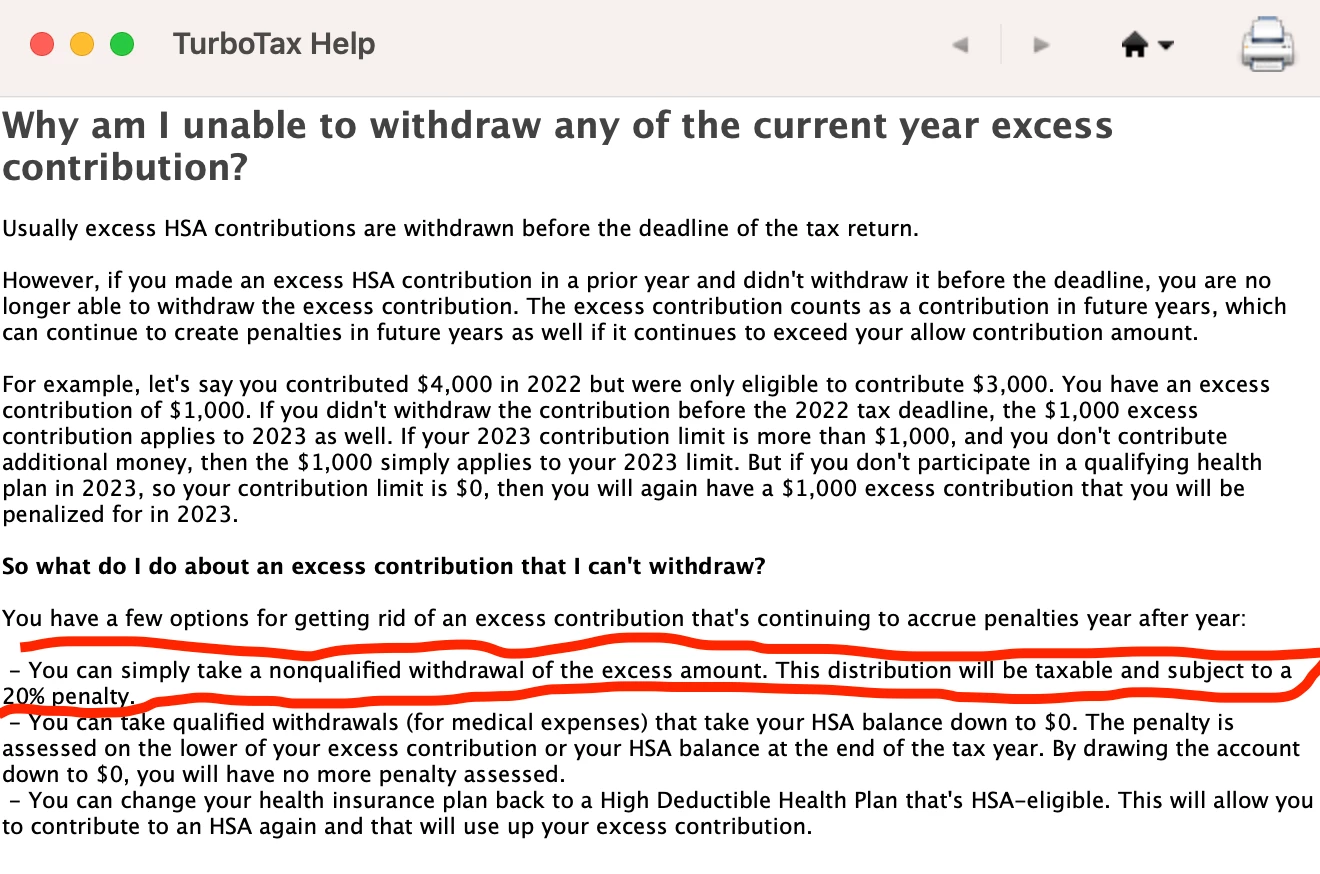
    (1) So it sounds like doing excess contribution removal is going to be more head ache in the future, it's why you recommend doing non-qualifying withdrawal instead. I found detailed explanation of this in Turbotax help as shown below  (with recommended by you option highlighted).But how will I report the non-qualifying withdrawal in Turbotax 2023? I don't know which options to choose below.
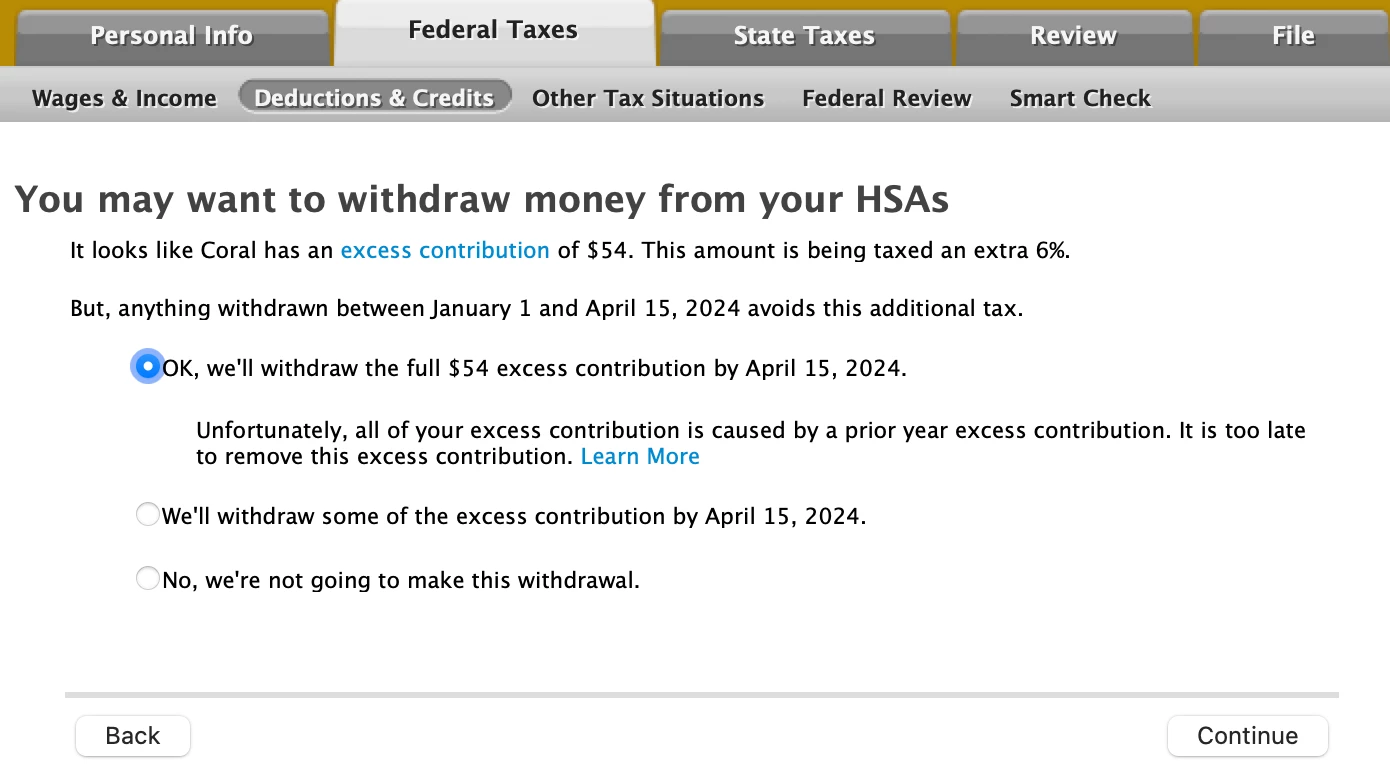
    1a) Should I choose option 1 above because we are withdrawing the amount of excess contribution, just as non-qualifying purchase?


    1b) Or should I choose option 3 since we are not removing the excess withdrawal directly? (if so, how Turbotax 2024 will know not to ask about these $54 excess?)

    1c) Can my wife withdraw more than excess plus interest in order for this to work? I don't think we can figure out interest reliably, so I'm guessing significantly larger sum than the interest (say, $75) should cover it, right?


    Working on your questions for question (2) now...


    Answer: "No, we are not going to make this withdrawal". This is because, as TurboTax pointed out, you can't withdraw as an "excess contribution" a carryover of excess from a previous year.


    1c) Oddly, when you make that withdrawal for a carryover in the years after the initial excess, you don't worry about the interest and earnings. That's what the 20% penalty is for.


    All the withdrawal for non-medical expenses has to cover is the original excess amount (the $54 in your case) that is being carried over.


    Form 5329 will figure out what you have done, and erase the carryover. It will, I promise.

    1 reply

    dmytrosAuthor
    March 27, 2024

    My wife just told me that she was wrong about which HSA account got excess contribution. It's not the closed account, but the one with >$54. I assume I should follow "choice 2" from this recommendation to unblock myself.

    KrisD15
    March 27, 2024

    The excess was made in tax year 2022.

    Following the directions given in the other answer, you will still pay the penalty on the excess for tax year 2023. 

    Make the distribution for the excess and any earnings in 2024. 

    Next year, you will report that as a non-qualifying distribution (to zero out the excess) and you will then pay tax on that distribution (report that it was NOT used for medical expenses).

    The excess will no longer be reported after tax year 2024.


    If you made distributions in 2023, you could do the same thing for 2023, claim part of the distribution (the amount of the excess) as non-qualifying. 

    **Say "Thanks" by clicking the thumb icon in a post**Mark the post that answers your question by clicking on "Mark as Best Answer"
    dmytrosAuthor
    March 27, 2024

    I think I understand what you suggested to do, but not what the difference it would make, or how to report it in turbotax in 2023 filings.


    My understanding of your recommendation is not to reach out to HSA provider asking for excess withdrawal (it's my understanding they would send me a check in this case). Instead you suggest to use HSA for non medical purposes (say, groceries) for amount that is larger than excess + earnings from excess.


    1. How does getting check from HSA provider different than spending money on non-qualifying purchases? What is the benefit of doing non-qualifying purchases?

    2. If I go this way, how do I unblock my 2023 filing in turbotax?


    I don't care as much if it's 6% or 12% or 100% of $54. Just looking for the easiest way to get rid of this head ache.



