
Employee
February 28, 2025
Solved

Exempt Interest , Box 12 of 1099-Div: What is the "State" for "State for where Dividends were earned"

  • February 28, 2025
  • 1 reply
  • 0 views

For Tax Exempt Interest Dividends in Box 12 of 1099-Div I have worked out the Interest for each State (messy but doable).  However the next line asks me to input the “State where the dividends were earned. Postal Code such as CA or NY”.


Is the “State where the dividends were earned”

  • The State I live in, which is CA (since “I”  “earned” those dividends and I live in CA)


 OR


  • The State(s)  where the fund invested in their muni or bond funds (e.g. 10% div in CA, 15 % div in MA, 20% div in MN etc)


The “State where the dividends were earned”  is a single State box (albeit you can enter xx for multiple states).


The question resides on what “earned” actually refers to i.e. did “I” earn the dividends or did the “fund” earn the dividends. Since “I” am the one paying taxes and taxes are on earned income (the funds don’t actually pay taxes, I do) then I assume it is the State I live in, but I would like a definitive answer.
 

    Best answer by SteamTrain

    @ChallengedinCA 

    It's best to go back to the actual 1099-DIV and answer the follow-up questions there in the interview...do NOT try to enter the codes and distribution in the Error check.

    ___________________

    Theya are asking about which states bonds produced the $$ In box 12.


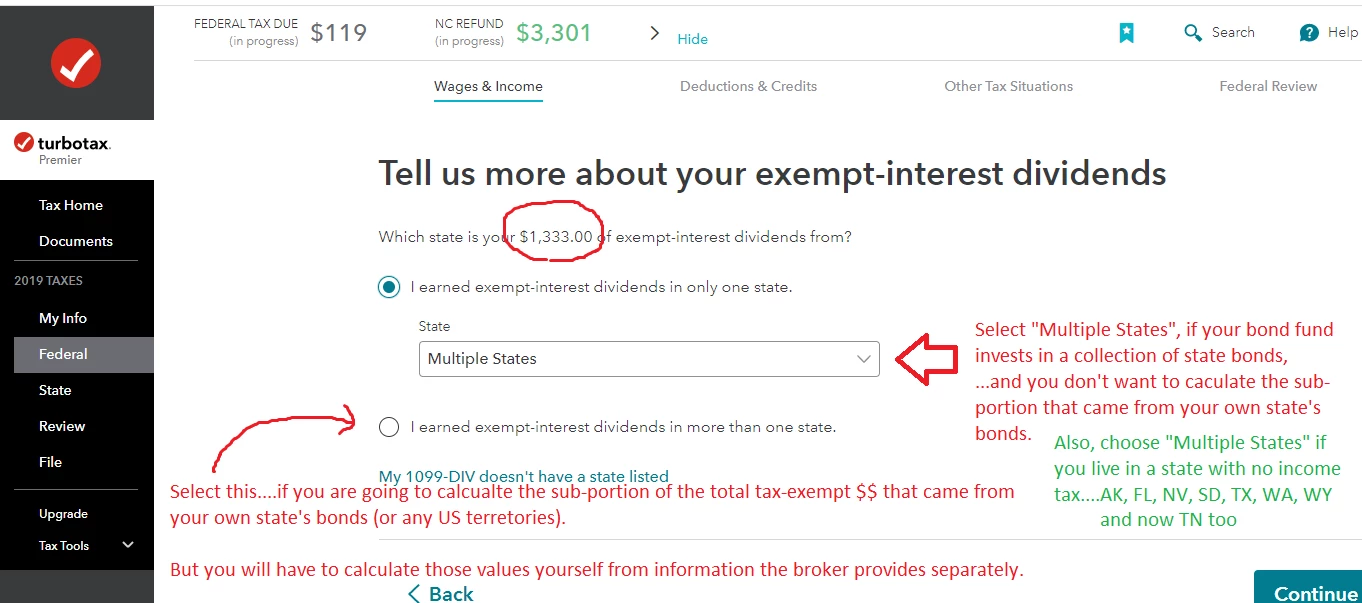
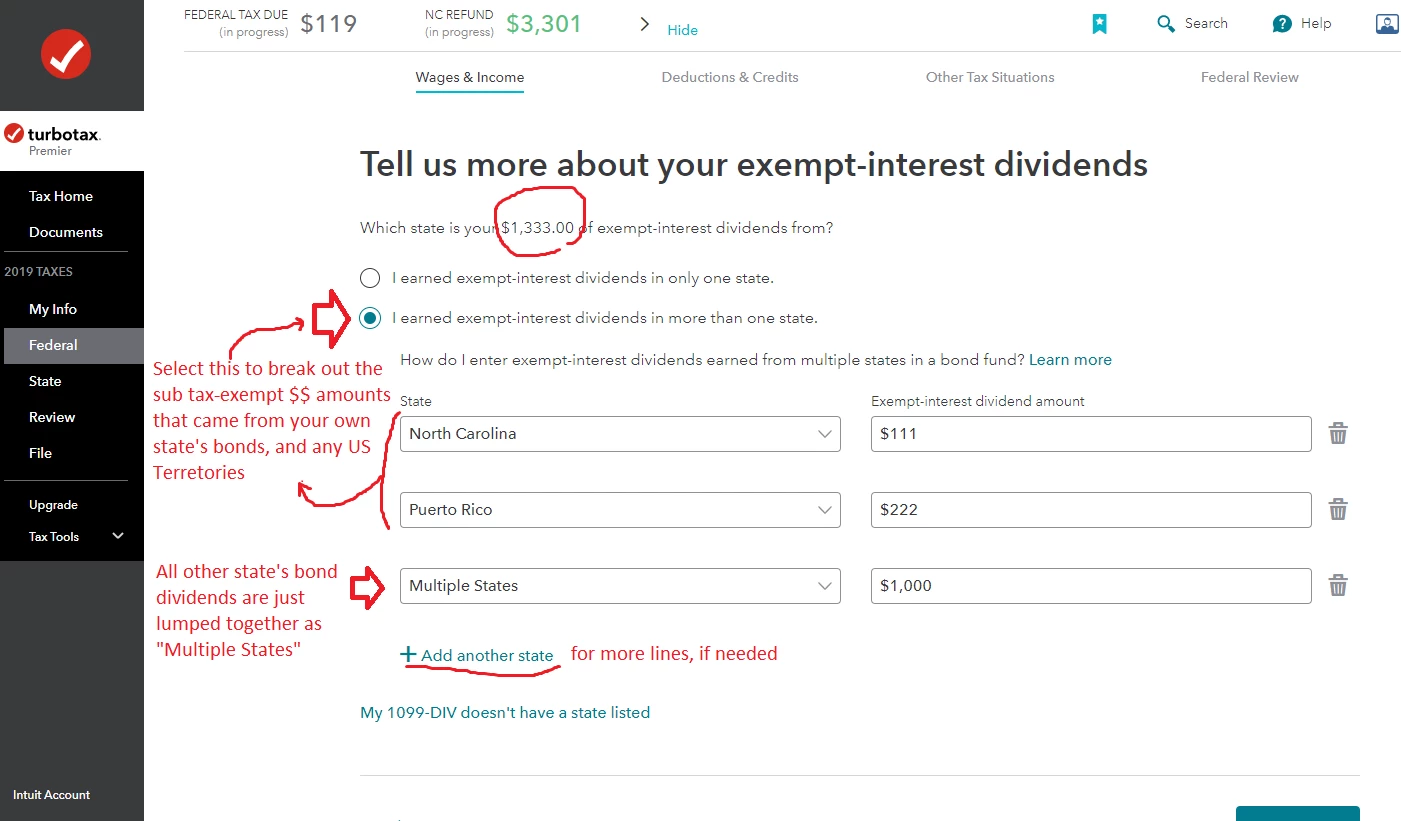
    For a CA resident, they cannot claim any of it came from CA unless the bond fund that produced those $$ held at least 50% of it's assets in CA Municipal bonds.  Most fund companies have special CA-specific bond funds for CA, and if you don't have one, then it must all be assigned to "Multiple States"

    ________________

    See below on how to make the correct selection on the follow-up page.


    1)  First picture is how to set all of box 12 to "Multiple States"...that is if you don't have any CA-specific Bond Funds (or a fund that happens to have more than 50% of assets in CA Muni's)


    2)  Second picture is how to break out CA if you do happen to own a CA-Specific fund  (ignore the PR entry...that's only for folks living in states where there are not restrictions like CA's)

    ___________________________________

    #1)


    _______________________

    #2)


    1 reply

    Employee
    March 2, 2025

    The state you live in does not charge taxes on muni income earned in your state. Therefore you need to enter the amount of dividends eaned in that state (ie CA) and the balance of the dividends in multiple states.

    Employee
    March 2, 2025

    Thanks for the answer, but do I enter "CA" or "XX" (multiple states) for 1099-Div box 12 where it asks "State where the dividends were earned” when I have Fed Tax Exempt Interest  of say $X in CA and $Y in multiple states other than CA.

    SteamTrain
    Employee
    March 2, 2025

    @ChallengedinCA 

    It's best to go back to the actual 1099-DIV and answer the follow-up questions there in the interview...do NOT try to enter the codes and distribution in the Error check.

    ___________________

    Theya are asking about which states bonds produced the $$ In box 12.


    For a CA resident, they cannot claim any of it came from CA unless the bond fund that produced those $$ held at least 50% of it's assets in CA Municipal bonds.  Most fund companies have special CA-specific bond funds for CA, and if you don't have one, then it must all be assigned to "Multiple States"

    ________________

    See below on how to make the correct selection on the follow-up page.


    1)  First picture is how to set all of box 12 to "Multiple States"...that is if you don't have any CA-specific Bond Funds (or a fund that happens to have more than 50% of assets in CA Muni's)


    2)  Second picture is how to break out CA if you do happen to own a CA-Specific fund  (ignore the PR entry...that's only for folks living in states where there are not restrictions like CA's)

    ___________________________________

    #1)


    _______________________

    #2)


    ____________*Answers are correct to the best of my knowledge when posted, but should not be considered to be legal or official tax advice.*




