February 27, 2025
Solved

How to Report Spouse’s Foreign Self-Employment Income in MFJ

  • February 27, 2025
  • 3 replies
  • 0 views

I am a U.S. resident alien filing as Married Filing Jointly (MFJ) with my husband, who is a self-employed sole proprietor in India. He lives in India, his business is based there, and he has no U.S. income or clients. He doesn't even have SSN and I'm applying ITIN for him. I want to correctly report his income in TurboTax and determine if he qualifies for the Foreign Earned Income Exclusion (FEIE) or Foreign Tax Credit (FTC).


  1. Should I enter his income under Self-Employment Income & Expenses (Schedule C) or under Foreign Earned Income & Exclusion (Form 2555)?
  2. Will he be subject to self-employment tax (15.3%) in the U.S., or does India’s Totalization Agreement provide an exemption?
  3. Since he pays income tax in India, would the Foreign Tax Credit (Form 1116) be a better option than the FEIE?
  4. If FEIE applies, how do I ensure TurboTax calculates it correctly?

I want to make sure I report his income correctly and minimize double taxation. Any guidance would be greatly appreciated!

Best answer by DaveF1006

Hi @DaveF1006 ,


Thanks for taking time and sharing your answers. But I'm still unsure of few things so let me explain what I have done and what are the questions I still have. 


Since I'm a W2 employee I don't have any issues in that but my husband is self-employed and has business in India. He has always been living there and he still does too. For tax purpose I'm treating him as RA so we can do MFJ. 


My husband has two business income one from plastics manufacture & second is from farming. 


Question 1 - Can you deduct GST as expenses from business income & below expenses looks fine?


First I reported it in Self-employment income and expenses section as below. 
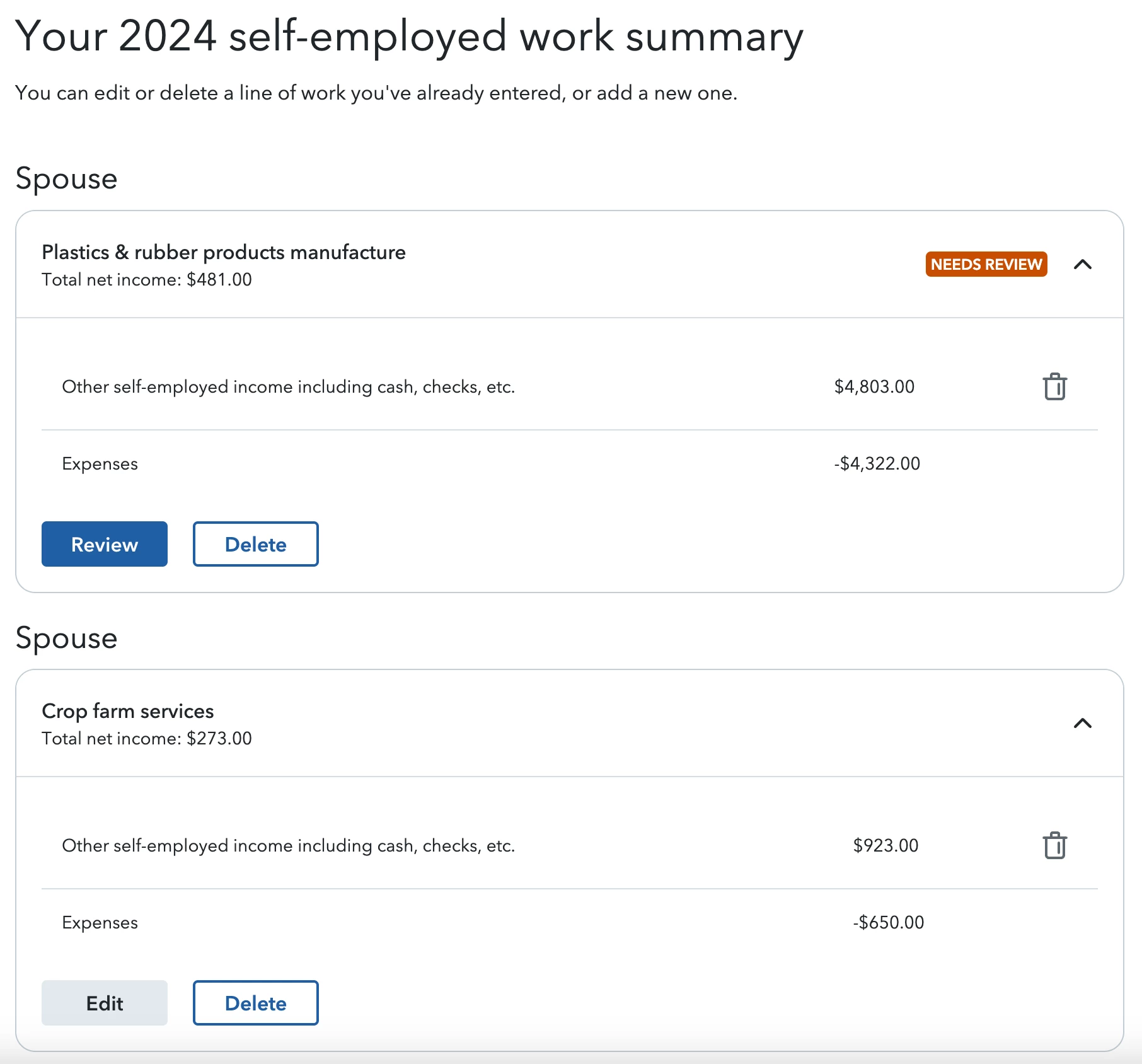
 In this I have questions about whether can I deduct the GST paid as Business expense or not? Based on the online information I have added it as Taxes & licenses expenses to deduct from the business income. Below I have provided screenshots to show how I'm doing it. 

 

Then for Farming, in India it is tax free so we don't bother about deducting expenses in Indian tax filing but in US even farm income is taxed so I'm deducting the expenses. I'm just attaching it below to verify if this is correct. 
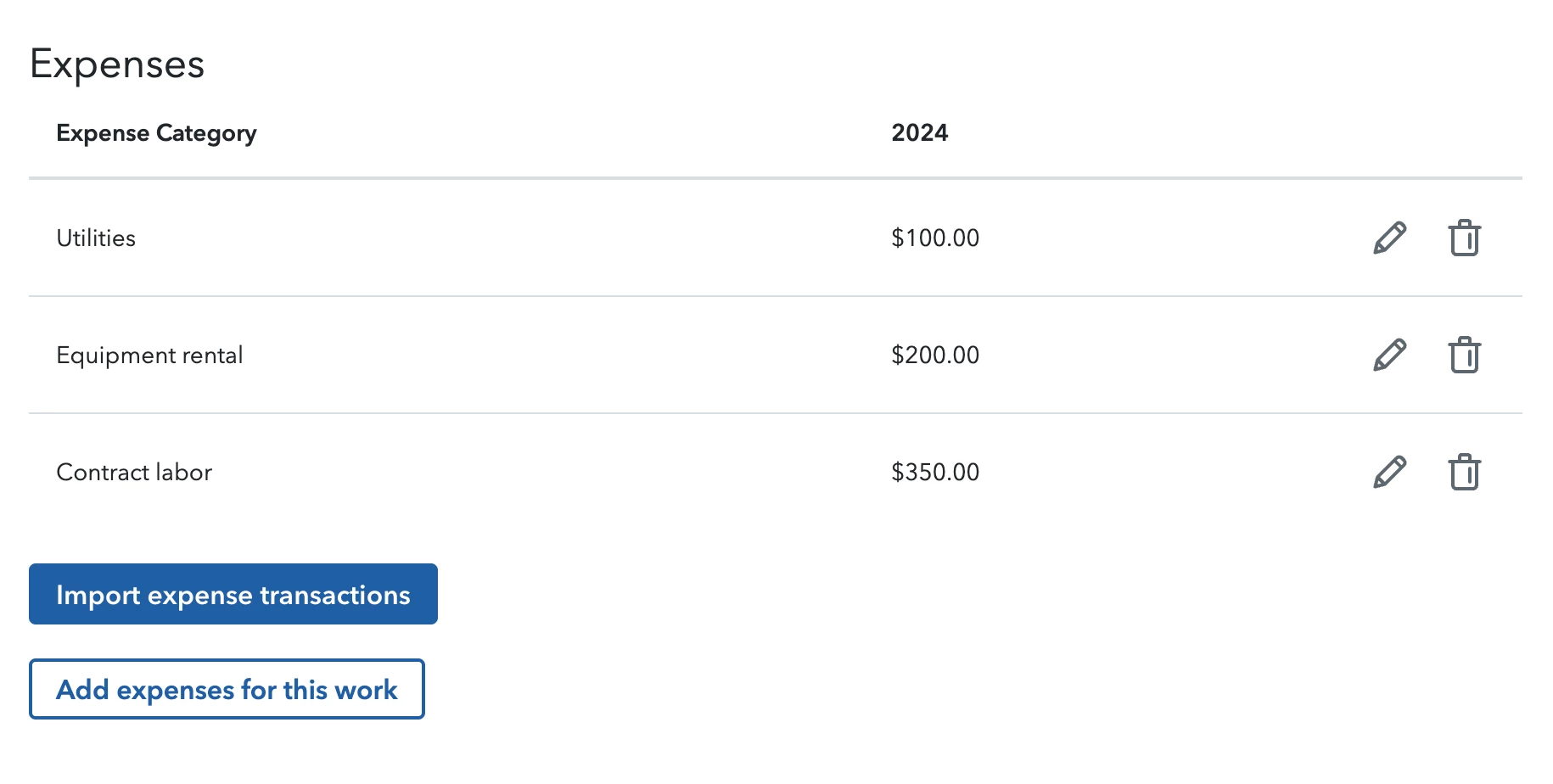


Question 2 - How much to enter as FEIE & whether business expenses deductions to be provide in this section?


Next I went to the Foreign Earned Income and Exclusion section since he qualified for exclusion because of Bone fide presence test. My question is based on the above business income and expenses what should I enter in FEIE section as gross profit. 

Scenario 1: Based on your previous suggestion if I'm entering the full business income.
      1. Business Income - 4803 ( Plastics )
      2. Business Income - 923 ( Farming)

FEIE - 5726 
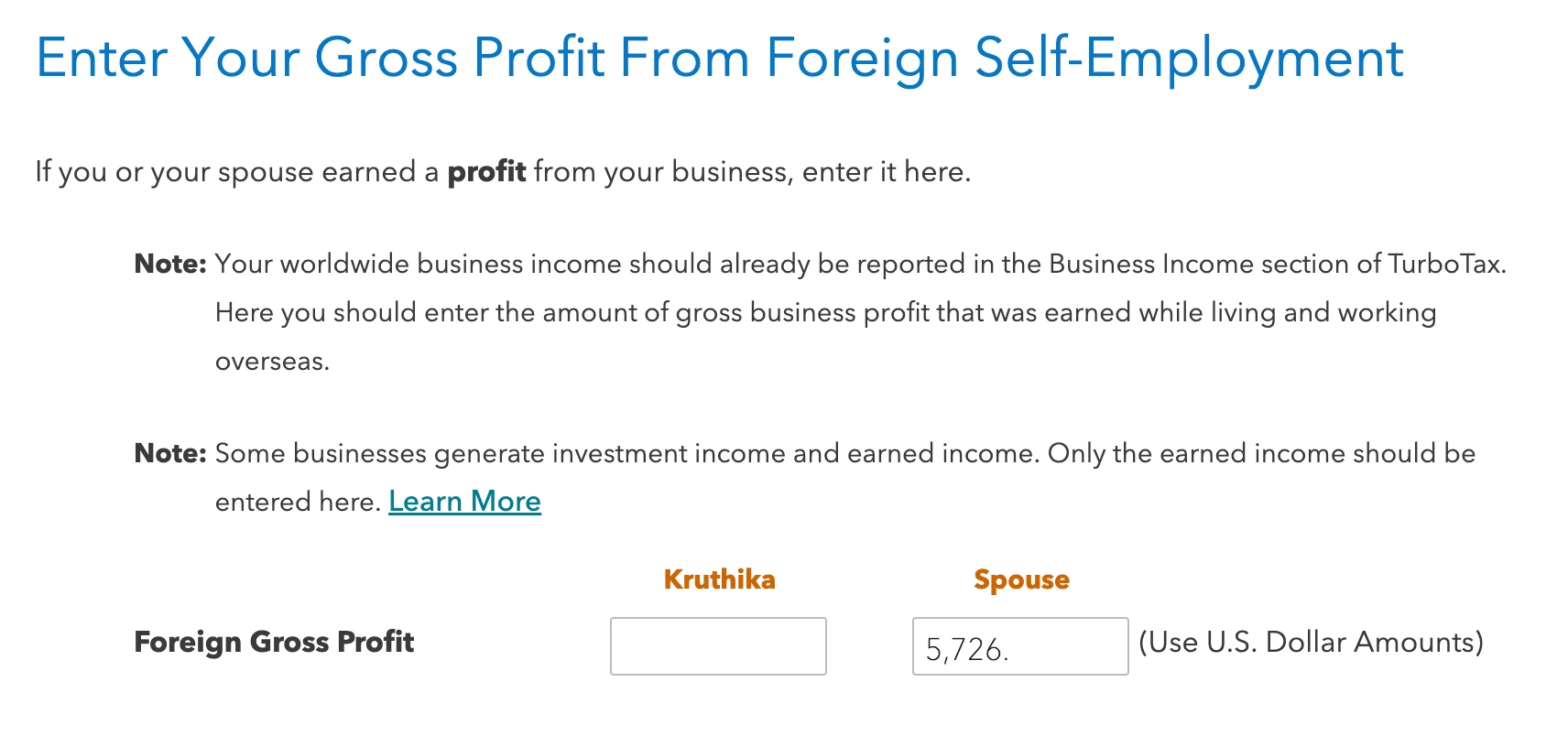
Scenario 2:  Based on the IRS pages & my understand [https://www.irs.gov/individuals/international-taxpayers/foreign-earned-income-exclusion-what-is-foreign-earned-income]

     1. Business Income - 4803 ( Plastics )

          Expenses - 4322

          Net Income - 481
      2. Business Income - 923 ( Farming)

          Expenses - 650

          Net Income - 273

FEIE - 754 (Maybe wrong but I want to double check instead of filing it wrong)


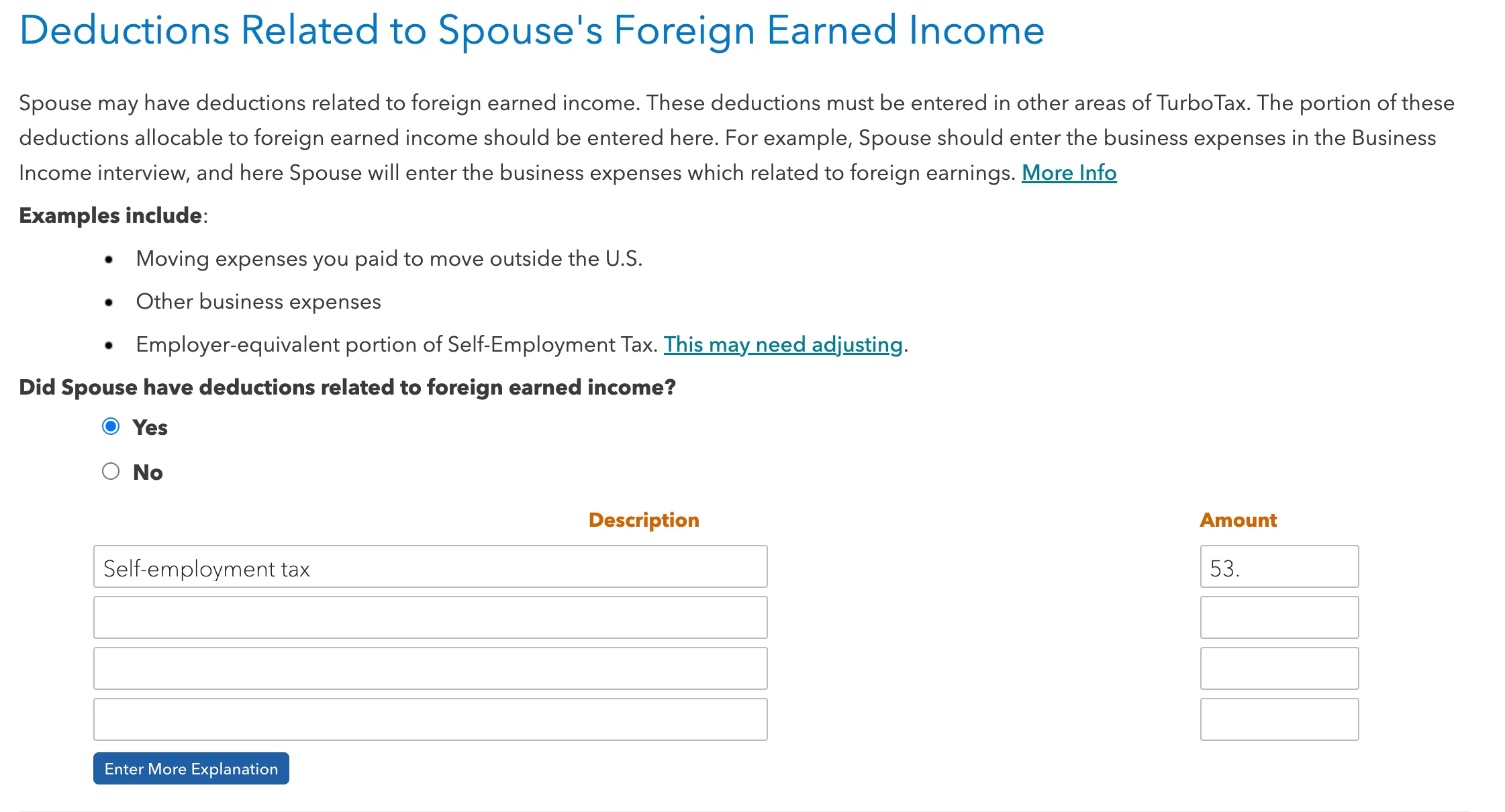
Question 3 - Do I need to enter the business expenses in this page?

After this comes this deductions section in which turbo tax adds the self-employment 1/2 automatically apart from that do I need to add any other business expenses that I'm claiming in the self-employment section ? 


Looking forward to your guidance. Thanks in advance. 


For the Farm income, I would not recommend filing a Schedule C, but instead use Schedule F. You report Farm income by going to income and then Rentals, Royalties, and Farm if using "Turbo Tax" online. 


Generally, Indian GST (Goods and Services Tax) is not deductible as a business expense on a U.S. tax return. This is because GST is considered a foreign value added tax, and the U.S. tax system typically does not allow deductions for foreign taxes paid if it is a value added tax.   If you file a Indian Tax Return (ITR) you may be able to claim a credit.


For the purposes of filing FEIE, all amounts are entered as gross income. You do not enter business expenses in this section. instead, these are entered in the Self-Employment and Farm income sections in your return. Instead it  asks for deductions and exclusions related to foreign housing.  

 

Foreign housing exclusion or deduction


3 replies

Employee
February 27, 2025

@kruthika , Namaste ji


What I get from your post :

1. You a US Person ( Resident for Tax purposes / GreenCard ), having a tax home in  US

2. Your spouse  is Indian citizen & resident  ( for purposes of the Tax Treaty ) is self-employed and is taxed in India.

3. You wish to file as MFJ

MFJ filing would require  

            (a)  A request signed by both filers, asking for the NRA to be treated as a Resident for Tax purposes.

            (b) the spouse to have US Tax ID (TIN ).

4. Note that  while this MFJ would  get you a higher  standard deduction  ( assuming you are not eligible  for head-of-Household filing status ), it would also the tax rate  of  your  US sourced income.  This is because  TurboTax will  first compute  the tax liability on the joint world income and then deduct from it the  tax  levied on the excluded income.

5. Also note that once the spouse has requested to be treated as a resident, it  remains valid  till  for the future years.   So one needs to look at the longer term  benefits.

6.  While  FEIE is available  for the  NRA spouse because of  foreign tax home ( form 2555 ),  the  Schedule-C  ( for sole proprietor/self-employed )  is prepared under US tax laws  and may be different  than under  Indian Tax laws.

7.  And yes because  of Totalization agreement between US-SSA and India , one need to pay  SECA to only one country ( with a certificate of participation from the other  country ).


Does all the above make sense ?   Is there more I can do  ?  You can either respond here or PM  me  -- especially if there are items that are not of general interest -- just NO  PII  ( Personally Identifiable  Information)


Namashkar ji


pk

DaveF1006
February 27, 2025

Yes, he can apply the Foreign income Exclusion, take the credit, or a combination thereof. Currently, the US does not have a totalization agreement with India according to this source so he would be subject to the self-employment tax in the US.  Here are some things to consider.


  1. US Taxpayers living in other countries have the option of taking a foreign tax credit or Foreign income Exclusion.(FEIE)
  2. If the Foreign Earned income Exclusion is elected, each taxpayer on a return may exclude up to $126,500 of their income in 2024.
  3. Foreign Earned income eligibility is based on the Physical Presence Test or Bonafide Presence Test
  4. If the Foreign Earned Income exceeds $126,500, a taxpayer is eligible to take a foreign tax credit for the remainder of income beyond the $126.500 limit.
  5. If the foreign tax rate is fairly low, it may be more advantageous to exclude your foreign income because the foreign tax paid is insignificant. 
  6. If the foreign tax rate is high however, it may be more advantageous to take the foreign tax credit (FTC) especially if the foreign income is high.

So now, you probably wondering how to report this?  Here is the order that I suggest. First report the Foreign income and see if it can be excluded.


  1. Click on Federal 
  2. Click on Wages and Income  
  3. Scroll down to Less Common Income
  4. On Foreign Earned Income and Exclusion, click on the start or update button. 


Now report this income on a Schedule C by going to Business Income and Expenses.  Here you will report his income and expenses to determine the self-employment tax. After this is complete, you will exclude the net income amount by doing this. 


  1. Select Wages and income
  2. Less Common income
  3. Miscellaneous Income, 1099-A, 1099>start
  4. Scroll to the bottom of the page to Other Reportable Income
  5. Other taxable income, answer yes
  6. Then give a brief description of the income and the amount listed. Here you will list this as Foreign Self-employment income excluded and record the net income as a negative number by placing a minus sign in front of the amount. All that is left in your return is the self-employment tax and an adjustment in Schedule 1 deducting 1/2 of the self employment tax.

If you decide to claim the foreign tax credit if a portion of his income is over  $126,500, you will report that here.


Go to Federal

  1. Deductions and credits 
  2. Estimate and other taxes paid 
  3. Foreign Tax Credit>start or revisit


As far as Turbo Tax reporting this accurately, we do have an accuracy guarantee policy in place. Please select that link for further information.


**Say "Thanks" by clicking the thumb icon in a post**Mark the post that answers your question by clicking on "Mark as Best Answer"
kruthikaAuthor
March 17, 2025

Hi @DaveF1006, I have completed all the steps as you mentioned in your thread. 

     1. Reported the my spouse business income in Schedule C 

     2. Reported the Farm income in Schedule F (Since he is actively involved and SE tax is calculated for this income too)

     3. In FEIE section he did qualify for exclusion so I put all the gross income from both & deducted 1/2 of SE tax. 

     4. In federal review page, it shows as - Other income, -$5,305 

    It looks like the amount I entered in FEIE after minus of 1/2 SE tax it is showing up as other income with minus sign.


My question in your thread you have instructed to do as below:


After this is complete, you will exclude the net income amount by doing this. 


  1. Select Wages and income
  2. Less Common income
  3. Miscellaneous Income, 1099-A, 1099-C
  4. Scroll to the bottom of the page to Other Reportable Income
  5. Other taxable income, answer yes
  6. Then give a brief description of the income and the amount listed. Here you will list this as Foreign Self-employment income excluded and record the net income as a negative number by placing a minus sign in front of the amount. 

Do I still need to do this manual exclusion ? Or is it not required as turbo tax will handle it on its own. Looking forward to your guidance. 


DaveF1006
March 17, 2025

 It depends.  This is how you will enter the information in the return.


  1. When you complete the foreign income exclusion section.  You would enter the full Gross amount of the foreign income. You wouldn't deduct 1/2 of self-employment tax. Just enter the full, gross amount of self-employment income and farm income. Don't deduct business or farm expenses in this section.
  2. Next, you will prepare Schedule C and Schedule F. After this is prepared, you will exclude the net income generated by both returns by the order of steps I have prescribed. After the income is excluded, the only remains is the self-employment tax and 1/2 of the self-employment tax.  

@kruthika 

**Say "Thanks" by clicking the thumb icon in a post**Mark the post that answers your question by clicking on "Mark as Best Answer"
DaveF1006
February 27, 2025

Yes, he can apply the Foreign income Exclusion, take the credit, or a combination thereof. Currently, the US does not have a totalization agreement with India according to this source so he would be subject to the self-employment tax in the US.  Here are some things to consider.


  1. US Taxpayers living in other countries have the option of taking a foreign tax credit or Foreign income Exclusion.(FEIE)
  2. If the Foreign Earned income Exclusion is elected, each taxpayer on a return may exclude up to $126,500 of their income in 2024.
  3. Foreign Earned income eligibility is based on the Physical Presence Test or Bonafide Presence Test
  4. If the Foreign Earned Income exceeds $126,500, a taxpayer is eligible to take a foreign tax credit for the remainder of income beyond the $126.500 limit.
  5. If the foreign tax rate is fairly low, it may be more advantageous to exclude your foreign income because the foreign tax paid is insignificant. 
  6. If the foreign tax rate is high however, it may be more advantageous to take the foreign tax credit (FTC) especially if the foreign income is high.

So now, you probably wondering how to report this?  Here is the order that I suggest. First report the Foreign income and see if it can be excluded.


  1. Click on Federal 
  2. Click on Wages and Income  
  3. Scroll down to Less Common Income
  4. On Foreign Earned Income and Exclusion, click on the start or update button. 

Now report this income on a Schedule C by going to Business Income and Expenses.  Here you will report his income and expenses to determine the self-employment tax. After this is complete, you will exclude the net income amount by doing this. 


  1. Select Wages and income
  2. Less Common income
  3. Miscellaneous Income, 1099-A, 1099>start
  4. Scroll to the bottom of the page to Other Reportable Income
  5. Other taxable income, answer yes
  6. Then give a brief description of the income and the amount listed. Here you will list this as Foreign Self-employment income excluded and record the net income as a negative number by placing a minus sign in front of the amount. All that is left in your return is the self-employment tax and an adjustment in Schedule 1 deducting 1/2 of the self employment tax.

If you decide to claim the foreign tax credit if a portion of his income is over  $126,500, you will report that here.


Go to Federal

  1. Deductions and credits 
  2. Estimate and other taxes paid 
  3. Foreign Tax Credit>start or revisit


As far as Turbo Tax reporting this accurately, we do have an accuracy guarantee policy in place. Please select that link for further information.


[Edited 02/27/25|11:45 am PST]


**Say "Thanks" by clicking the thumb icon in a post**Mark the post that answers your question by clicking on "Mark as Best Answer"
kruthikaAuthor
February 28, 2025

Thanks Dave for answering. But I'm still confused.


In turbo tax I'm seeing two options

       1. Self-employment income and expenses

       2. Foreign Earned Income and Exclusion


My doubt is whether I should fill up the numbers from his business income (from India) information in option 1 or option 2 under the income and expenses section. As both as completely different effect. I'm trying file the tax as MFJ and so he gets treated as resident alien and he will get his ITIN as well. 


Option 1 - I'm seeing tax payable amount increasing.

Option 2 - I'm seeing tax payable amount decreasing. 


In my understand option 1 is for US self-employed individuals right? Since my husband is self-employed but in India I thought maybe I need enter his business income details in option 2. But I just want to double check before I file my tax returns.  


DaveF1006
February 28, 2025

Yes, let me rephrase everything I just mentioned. OK, first of all, you need to enter his income in the Foreign income Exclusion to report it and to see if he qualifies for the exclusion based on the Physical Presence Test or the Bona fide resident test. If he doesn't qualify, then remove all the entries from this section. 


Now, you do need to fill out a Schedule C in the manner I prescribed. This will need to be prepared so that the self-employment taxes can be assessed. If your husband qualified to have his income excluded in the first step, then exclude his net income from this section in the manner I prescribed. 


However, if his income could not be excluded, then leave the Schedule C income untouched. You would not want to enter this business income strictly in option 2 because if you did, the self-employment tax would not be reported in the return. That is why your tax payable amount decreased because the self-employment tax is absent in this option.


Since India doesn't have a totalization agreement and since you wish to declare your husband as a resident alien for tax reporting purposes, he does need to pay self-employment tax to the US regardless where he lives.

**Say "Thanks" by clicking the thumb icon in a post**Mark the post that answers your question by clicking on "Mark as Best Answer"