
March 26, 2025
Question

K-1 with Box 1 and Box 2 values -- how to fill out 2 K-1s?

  • March 26, 2025
  • 3 replies
  • 0 views

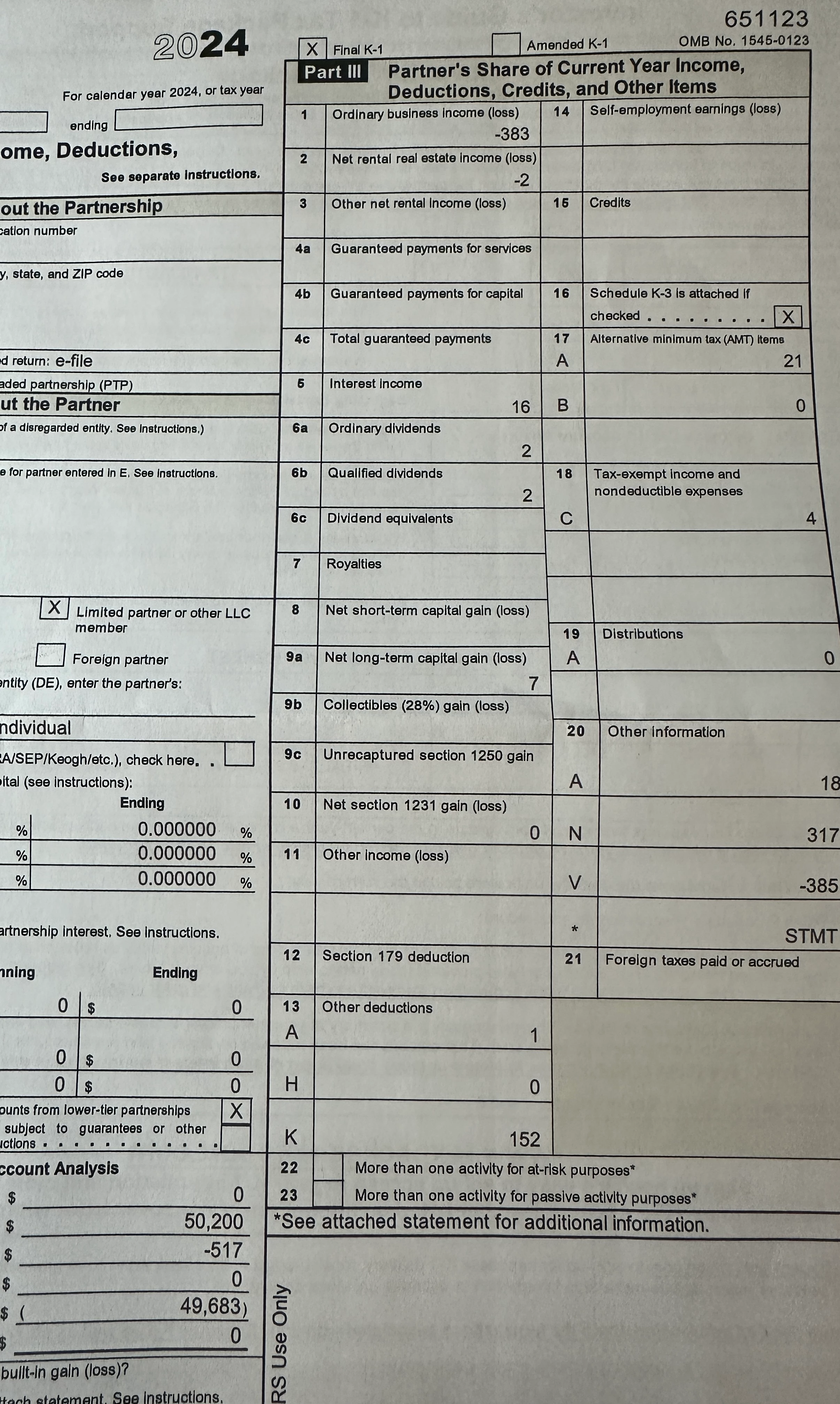
We bought and sold stock last year, which resulted in both a 1099-B and a K-1. (The stock apparently is a PTP).

The K-1 has a number in both Box 1 and Box 2. Because of this, TT states that I need to enter two K-1s.

Does this mean I have to enter 2 identical K-1s where I input the same name, address, Capital Account Info, Partnership description, and all Sale Information for both K-1s? And so the only part that differs is when I get to the TT screen of "Choose Type of Activity"?


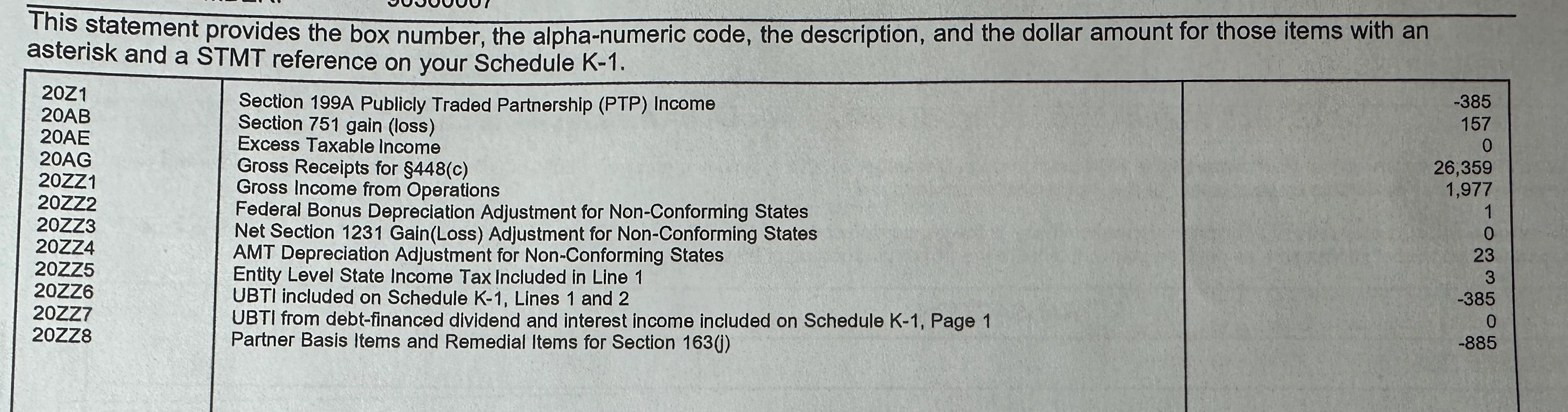
Once I get to that screen, I am not sure which boxes should go with which K-1. I read a post that had a similar question and was answered by @Mike9241 , so maybe he can help? From that post, it seems that I can enter ALL other boxes (4-19) on the K-1 with Box 1 (Ordinary business income). But I have many entries in box 20, so am not sure which K-1 those items need to go with. 

I am tagging @Rick19744  as well, since he recently helped me on another K-1 (this is a new K-1 that just arrived)

Can someone also tell me which boxes should be entered with which K-1? Also, can I assume that each box should only be entered on one of the K-1s, and not both.


Here is my K-1 for reference:
And here is the corresponding statement for Box 20:
Thank you!

    3 replies

    March 26, 2025

    Yes, two almost identical K-1s.  One K-1 with everything except Box 2.  The second K-1 with just box 2.  

    **Say "Thanks" by clicking the thumb icon in a post**Mark the post that answers your question by clicking on "Mark as Best Answer"
    March 26, 2025

    @DavidD66 is technically correct to use two K-1s. However, to simplify things, since you disposed of it, is to combine box 2 with box 1 and only have one K-1. The final results will be the same as if you had used two and completed them properly.

    ***********

    I suggest this for several reasons. The disposition/sales worksheet you got combines lines 1, 2 and certain other lines on the K-1. Also, line 20Z1 combines both lines. Turbotax will not like it if you report the entire 20Z1 on the first K-1 because the amount will not match line 1. You would have to enter -383 on the first K-1 and -2 on the second

    *************

    Certain other lines will cause you issues. Line 13K is excess business interest that has not been deducted from lines 1 or 2. To determine deductibility, you need to complete Form 8990. Turbotax does not handle this form. You are mostly on your own or would have to post additional questions in this forum. If any is deductible, you'll need to adjust the appropriate tax form - probably line 1 of the K-1. 

    ************

    The K-3 box is checked. Whether there are items you are supposed to report is unknown. Most K-3s won't come out until much later. See the letter that accompanies the K-1 package.

    *********************************

    Here are the guidelines for reporting the disposal. I do not know how 13K is reflected in the sales schedule. t your basis should be 49683 - the same as ending capital plus 157 the 751 gain + any amount of 13K that is not deductible.


    MLP and PTP reporting k-1 and 8949


    Please follow these instructions. Incorrect entries can result in entering the sale twice or otherwise incorrectly. Also see the sales schedule that was included with the k-1


    Enter the k-1 info

    Check the PTP box

    If total disposition proceed as follows:

    Check final K-1 (s/b marked on actual k-1)

    Check sold or otherwise disposed of entire interest


    On the k-1 disposition section for sales price use the ordinary income (sometimes you’ll see a column with the “751” or the words “Gain subject to recapture as ordinary income” or similar wording. This info comes from the supplemental sales schedule that should have been provided. Its also now on the k-1 box 20AB - no 20AB, no ordinary income column then then sales price is zero. The numers I’m using represent the line numbers in forms mode (desktop only)

    1. Sales Price = line 20AB (1065 k1)
    2. Selling expenses = 0
    3. Basis = 0
    4. Gain is computed and should be same as the sales price.
    5. Ordinary gain = enter same as sales price

    This amount flows to form 4797 line 10 and is taxed as ordinary income. This step is necessary, so any suspended passive losses are now allowed.

    10,11,12 should be blank


    Now for the 8949.

    The broker’s form is probably coded as B or E (uncovered) – sales proceeds but not cost basis reported to the IRS. This is because the broker does not track the tax basis. It used what you paid originally which is not correct.


    The correct tax basis is:

    What you paid originally, should be the same as what is on 1099-B as cost,

    Then there is a column on the sales schedule that says cumulative adjustment to basis. If it’s positive add it to the original cost. If it’s negative subtract the amount. 

    Finally add the amount of ordinary income reported above, if any.

    The result is your corrected cost basis for form 8949.


    mellynleeAuthor
    March 28, 2025

    @Mike9241 - thank you for your response and detailed explanations.

    To clarify, I will enter everything as one K-1, and put -383 in Box 1. (-383 + -2 = box 1+box2)

    -----

    Regarding the K-3: It will be available at the end of June, so I am filing an extension. I'm hoping that I won't have to do anything with the K-3? The letter that came with this K-1 package stated the following: "...all of our income is effectively connected with a US trade or business. However, a limited number of unitholders (primarily foreign unitholders, unitholders computing a foreign tax credit on their tax return and certain corporate and/or partnership unitholders) may need the detailed information disclosed on Schedule K-3..."

    ----

    In response to your statement: I do not know how 13K is reflected in the sales schedule. t your basis should be 49683 - the same as ending capital plus 157 the 751 gain + any amount of 13K that is not deductible.

    Here is a pic of my Sales Worksheet that was also included that might help:


    I highlighted the comment for Column 7 - not sure if it's important for capital gain calculations.

    -------

    I followed your instructions for the K-1 Sales Info. Lines 5, 8 and 9 are all 157 (line 20AB).

    You then said: This amount flows to form 4797 line 10 and is taxed as ordinary income.

    I wasn't sure what you meant here, since Form 4797 line 10 is:

    10(a): From K-1

    10(g): 3759

    Line 10g is not equal to 157. Is it adding 157 to another number?

    ----

    I then continued to modify Form 8949 by reentering numbers in the TT interview section for my 1099B.

    I computed my new correct tax basis:

    50,200 (original 1099B cost)

    -517 (Column 5 of Sales worksheet - Cumulative adjustments to basis)

    157 (Column 7 of Sales worksheet - Gain subject to recapture as ordinary income)

    So my new tax basis is: 49840

    You mentioned (above) that my basis should be 4968350200 - 517 is equal to 49683. But you also said to add any amount of 13K that is not deductibleBox 13K is 152. I added 157 above.

    Did I calculate the tax basis correctly?

    -----

    To "adjust" the cost basis of this stock on the TT interview, should I enter the Cost Basis as it is listed in my 1099B, and then check the box "The cost basis is incorrect or missing on my 1099-B" And then 2 screens later, I should check the box "I know my cost basis and need to make an adjustment" and enter the "Actual Cost Basis" here. ??

    ----

    One more question. I have another K-1 that is very similar (PTP stock that was a short term capital loss) that @Rick19744 helped me out with. His method was slightly different, but I believe amounts to the same result - that my sale is not entered twice (once on K-1 and once on 1099B). The difference is that I think all of the gain/loss is on the K-1, and we zeroed out the gain/loss on my 1099-B.

    Will any flag be raised to IRS because I used 2 different methods to enter the 2 K-1s?

    Here is the link to that discussion: 

    https://ttlc.intuit.com/community/taxes/discussion/help-filling-out-sale-information-for-final-k-1/00/3572598/highlight/false 

    (Warning: It's pretty lengthy!)


    Thank you!

    March 29, 2025

    you do not use line 2 on the one k-1. The -385 is entered only on line 1. TurboTax does not accept entries on multiple lines 1, 2 or 3

    $3759 is the correct number on the 4797 because it is the 751 recapture from both k-1's


    for the one we're dealing with 

    In the AMT column, you enter 21 as basis and 136 as ordinary gain

    ^^^^^^^^^^^^^^^^^^^


    on schedule D, you enter your sales price.   your basis is 49683+157+152 (line 13k) (as per instruction for column 5) 


    as to column 7 instructions, entering a negative 157 in column G (code B)  on the 8949/schedule D is the same as adding to your basis. that's the way I do it because basis is not reported to the IRS by the broker.

     HERE'S WHAT THE FORM 8949 INSTRUCTIONS SAY TO DO WHEN THE BASIS (AS REPORTED ON 1099-B) IS WRONG 

    • If this transaction is reported on a Part I with box B (SHORT-TERM -UNCOVERED ) checked at the top,  enter the correct basis in column (e), and enter -0- in column (g). AND ENTER ADJUSTMENT CODE B

    YOU CAN'T ENTER 0 IN COLUMN G OR USE CODE B IN THE ONLINE VERSIONS. 

    Rick19744
    Employee
    March 26, 2025

    I agree with @Mike9241 in general.

    The only issue I potentially see is how you handled this K-1 in the past.

    From the questions asked, it doesn't appear that you had this K-1 in past years??

    If you did, and you entered the real estate activity separately, then you may have suspended losses that need to be combined with the single entry method in this final year.

    *A reminder that posts in a forum such as this do not constitute tax advice.Also keep in mind the date of replies, as tax law changes.
    mellynleeAuthor
    March 27, 2025

    Yes, you are correct in that I did not have this K-1 in the past. Both of the K-1s I have were generated as a result of having purchased and sold stock that were PTPs. Both were short term sales - purchased and sold in 2024, so these are our only K-1s.

    I will try to follow @Mike9241 's directions, but I am sure I will have some more questions...




