
Employee
March 11, 2022
Solved

Tax expert: How to avoid double-tax for the uncovered stock trasactions using Turbotax

  • March 11, 2022
  • 2 replies
  • 0 views

I traded some stocks in 2021 and they were marked as NOT COVERED TAX LOTS (Box B checked) on 1099B

Then the stock company also mailed me the 1065 Form/Schedule-K with the sales schedule.


I imported 1099B to TT and TT automatically calculated the capital gain for these not covered stock transactions using the cost basis and proceeds recorded on 1099B, of course, these capital gain will be taxed.


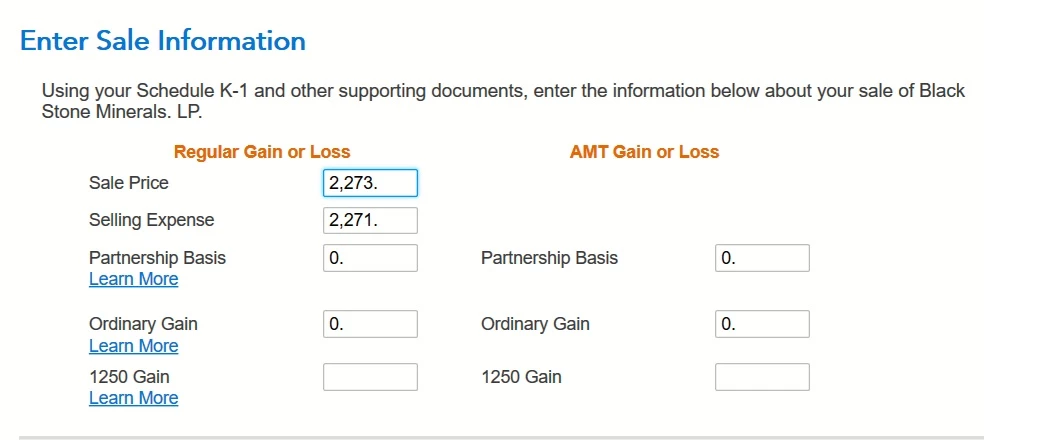
But when I entered the Schedule-K and selected 'This is a publicly traded partnership', 'This partnership ended in 2021' , 'Complete disposition" and 'Sold partnership interest" . TT asked me to enter 'Sale Price' and 'Selling Expense'. Please see the screenshot below. I entered cost basis for Selling Expense, and Proceeds for Sale Price, but if so, the gain is taxed again.


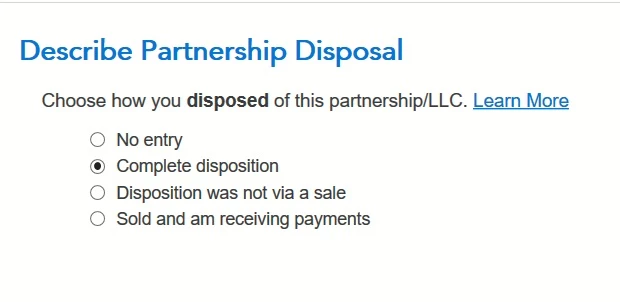
I found if I selected 'No Entry' instead of 'Complete disposition'. I wouldn't be asked to Sale Information, but is it right?
    Best answer by nexchap

    @manbeing MLP is Master Limited Partnership, but it doesn't matter.  The only thing you need to do is enter the $1 in the Ordinary Income box, and then set the Cost Basis to -1.  Do the same in the AMT column (using whatever the sales schedule tells you the AMT Ord Income is).  That will make sure the K-1 doesn't create a new 1099-B for the sale, and you can use the existing one to handle the Cap Gain.


    Note that the broker who gave you the 1099-B doesn't see the K-1.  If the K-1 includes any adjustments to your cost basis, you need to change the cost the broker gave you.  That's why the broker doesn't report it to the IRS:  they don't know if its correct or not.

    2 replies

    March 11, 2022

    TT doesn't have an automated way to deal with sales that provide both a 1099-B and a K-1.  In your case, you want to enter 'complete disposition', but on the sales screen just enter 0 for sales and cost.  That will avoid the double count.


    Note this assumes you didn't have any Ordinary Income noted on the sales schedule.  If you did, it gets trickier and this thread will help:  https://ttlc.intuit.com/community/investments-and-rental-properties/discussion/how-i-report-the-sale-of-mlp-shares-in-turbo-tax-i-sold-all-shares/00/776624


    **Say "Thanks" by clicking the thumb icon in a post**Note also, I'm not a Tax Preparer/CPA. Just a volunteer, seasoned, TurboTax user. Use any advice accordingly!
    manbeingAuthor
    Employee
    March 11, 2022

    Thanks. Unfortunately, I have $1 ordinary income recorded on the sale schedule.

    I am looking at the link you provided. What does 'MLP' stand for?


    nexchapAnswer
    March 11, 2022

    @manbeing MLP is Master Limited Partnership, but it doesn't matter.  The only thing you need to do is enter the $1 in the Ordinary Income box, and then set the Cost Basis to -1.  Do the same in the AMT column (using whatever the sales schedule tells you the AMT Ord Income is).  That will make sure the K-1 doesn't create a new 1099-B for the sale, and you can use the existing one to handle the Cap Gain.


    Note that the broker who gave you the 1099-B doesn't see the K-1.  If the K-1 includes any adjustments to your cost basis, you need to change the cost the broker gave you.  That's why the broker doesn't report it to the IRS:  they don't know if its correct or not.

    **Say "Thanks" by clicking the thumb icon in a post**Note also, I'm not a Tax Preparer/CPA. Just a volunteer, seasoned, TurboTax user. Use any advice accordingly!
    March 11, 2022

    you sold A PTP

    you enter the k-1

    in the k-1 section indicate complete disposition then use the link to enter the disposition info

    on the k-1 you do not enter the 1099-B reporting.  the only thing that gets entered here is "sales price"  which will show up on a supplemental schedule as ordinary income or section 751 income. this flows to form 4797

    that's the sales price for this section

    cost=0

    ordinary income is the same as the sales price


    when you sell a pTP there is a substantial amount that is treated as ordinary income and not capital gains.  this gets added to the tax basis provided to determine tax basis for capital gain loss/purposes. 

    with this oridary income add to tax basis yo can actually end up with a cpaitallos


    oh, besides this there is the QBI info that needs to be enrter. usually in box 20 (or sometin=mes scedure A- it may say 199A income)


    that gets enter in a separate section of the k-1


    good luck.


    in the 1099-b section you must correct the cost.


    there should be a sales schedule provided that will allow you to computer your correct tax basis.




