February 9, 2023
Question

ADU added to property with another rental

  • February 9, 2023
  • 1 reply
  • 0 views

Hello,


I have a standard 3br house that I've rented out for 7+ years. I just recently had a detached an ADU built on the same property (most of labor came from myself), which was put into service 3/1/2022. Both the house and ADU are/have been rented out. Have separate addresses, and utility hookups. And I have no mortgage on either of them.


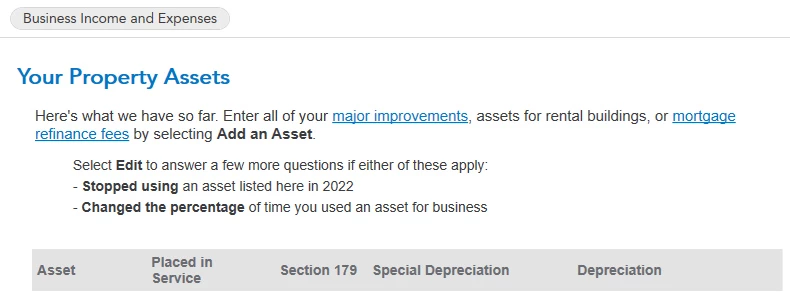
One question is, would I enter the ADU as its own property under "Rental and Royalty Summary" or would I add it under the original house's property under "Your Property Assets" as a "major improvement?" (see pics).


Also, would the rental income that I made from the new ADU just be combined with the original house's rental income, if I did add it as a major improvement?


Lastly, I understand if I depreciate the total cost basis as a major improvement, would I be able to do individual appliances as well on top of the total?


Hope this makes sense, entering uncharted territory. 🙂


Thank you!



1 reply

Carl11_2
Employee
February 9, 2023

Have separate addresses, and utility hookups. And I have no mortgage on either of them.

You can do either way. But what may be best depends on one factor we don't know.

Before the ADU, did you receive one property tax bill for everything?

After the ADU, do you still receive one tax bill for both structures and the land they are on? Did you take necessary actions to sub-divide so that each property is taxed separately now by your property taxing authority? (The county I presume.)


B_ElivAuthor
February 9, 2023

Hey! Thanks for the reply.


Before the ADU, did you receive one property tax bill for everything?

Before the ADU was built I got one property tax bill for the one parcel.


After the ADU, do you still receive one tax bill for both structures and the land they are on?

I do not get a separate tax bill for the ADU on the property currently. Nothing comes up when I type the ADU's address in the assessor's website, so I'm assuming its all the same still.


Did you take necessary actions to sub-divide so that each property is taxed separately now by your property taxing authority? (The county I presume.)

I did not sub-divide the parcel. It is still one big parcel.


What do you think would be best for my situation? Thanks again.

Carl11_2
Employee
February 9, 2023

While there's two ways to treat this, here's how I would do it. Regardless of the method you chose, there's pros and cons to both.

I'd just add the ADU as an additional asset to the existing rental, classified as residential rental real estate depreciated over 27.5 years. For that asset in the COST box I'd enter the amount I actually paid for that structure. Then in the COST OF LAND box enter zero, because I did not pay anything for the land I already own and built it on.

Pros :

 - You just enter one figure for the total rent received from both structures. If you have one structure vacant for a period of time between renters, no big deal. You really don't have any vacant period so long as at least one of the rentals is occupied by a paying renter for the entire tax year. The only way you'd have a vacant period, would be if both rentals were vacant at the same time.

 - I don't have to pro-rate and allocate land values between the two rentals, which can make for a "tenie-tiny" hassle adjusting the land value on the existing rental without messing up the existing structure value - which could completely screw up the depreciation history if not done right.

 - I don't have to bother with allocating insurance and property tax deductions between two separate rentals. (Assuming you have one policy for the entire property, and did not take out a separate policy for the ADU)

 - If I for any reason, convert either one of the units to personal use, it's just a simple matter of converting that one asset to personal use to stop depreciation on that one asset. (converting back to a rental will require manual math and a bit of work on your part, no matter what you do. It's just unavoidable.)

- If you sell the entire property in the future, you only have to report a single transaction, and don't need to bother with splitting it between two separate properties.

 - Cons:

 - If you sell only one of the structures, more than likely this scenario will include a portion of the land in the sale requiring you to report the sale as two separate transactions and adjust the land allocation on the unit you keep, accordingly. (one sale for the structure, the other sale for a portion of the land.) While a bit of work, it's perfectly doable and, if done right would reduce the land value according for the portion of land you keep, and not mess up your depreciation history on the structure you keep.

 - If you have any "personal use" of either structure while it's classified as a rental, it will require a bit of manual math on your part to get the allocations right.

 - If you convert only one of the units to personal use and stop depreciation on that unit for a period of time, and then later want to convert it back to a rental, it's not as simple as selecting the option to indicate you converted it from personal use back to a rental. it will "require"  some manual math on your part and a completely new entry in the assets/depreciation section.