
February 27, 2023
Solved

How do I force Turbotax to divide mortgage interest and property tax for first year rental converted from personal use

  • February 27, 2023
  • 2 replies
  • 0 views

The situation I have:

In 2022, I bought a new house B and moved from my old house A on 6/1. I put house A online and got the tenants on 7/15 who have rented since then. House B became my primary residence, and house A was converted from personal use to a rental property. I believe I will get divided mortgage interest and property tax for schedule A and E. However, turbotax doesn't allow me. Specifically it's the following restriction on personal use days in the interview flow:
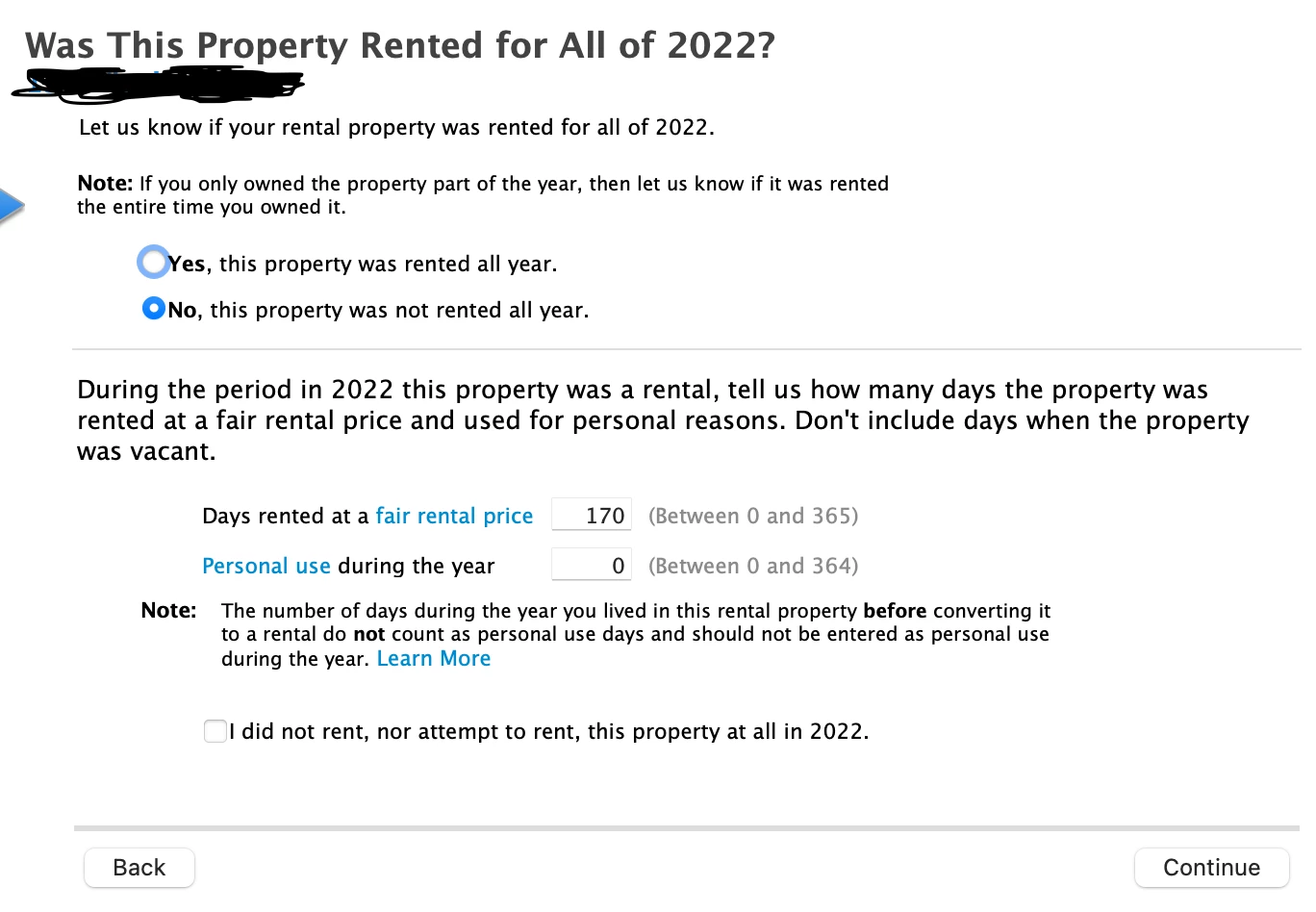


It clearly said that "The number of days during the year you lived in this rental property before converting it to a rental do not count as personal use days and should not be entered as personal use during the year."

Therefore, I put 0 for personal use. That means TurboTax will not be able to divide my mortgage interest and property tax based on rented days and personal days, which I confirmed by checking the schedule A and schedule E. Does anyone have the same issue when they become landlord for the first time and need to fill schedule A and E correctly?


The closest answer I found is this post, but I don't believe it gave the correct answer. Firstly, I think the statement in the answer is wrong: "Make sure you said it 'was rented all year' (which means all year after available for rent).". If you selected "was rented all year", you won't even be able to see the options for rented days and personal use days. Secondly, the note on the screen clearly says the days living in this property before conversion does NOT count as personal use days, and the answer in that post still did that just trying to have turbotax make the split.


Thanks in advance.

    Best answer by AnnetteB6

    In this case, when the property is converted from personal use to rental use, TurboTax does not do the math for you and report the prorated taxes and mortgage interest on Schedule A and Schedule E.  You will need to calculate the personal portion and the rental portion and enter the proper amounts in each section of your return.


    The messaging that you see onscreen in TurboTax when you indicate that you converted your personal residence to a rental property tells you that you will need to enter the details in both the Deductions and Credits section for the time the property was your residence and in the Rentals and Royalties section for the time the property was used as a rental.


    Also, you are correct in not entering any personal use days after the date it was converted.

    2 replies

    AnnetteB6Answer
    February 27, 2023

    In this case, when the property is converted from personal use to rental use, TurboTax does not do the math for you and report the prorated taxes and mortgage interest on Schedule A and Schedule E.  You will need to calculate the personal portion and the rental portion and enter the proper amounts in each section of your return.


    The messaging that you see onscreen in TurboTax when you indicate that you converted your personal residence to a rental property tells you that you will need to enter the details in both the Deductions and Credits section for the time the property was your residence and in the Rentals and Royalties section for the time the property was used as a rental.


    Also, you are correct in not entering any personal use days after the date it was converted.

    **Say "Thanks" by clicking the thumb icon in a post**Mark the post that answers your question by clicking on "Mark as Best Answer"
    Carl11_2
    Employee
    February 27, 2023

    I've dealt with that three times in the past, each year I acquired a rental property. (Have 3 now). I suggest you not elect to have the program do any automatic splits, as it rarely does so correctly. Instead, elect to do any splits manually.

    Also, be aware that absolute perfection in that first year is not an option; it's a must. Even the tiniest of mistakes can (and will) grow exponentially over time. Then when you catch it, usually years later when you sell the property, the cost of fixing it will be $expensive$.

    In my personal opinion, I've found that some screens don't provide the clarity I think it should, and on other screens the clarity is there, but folks just don't read the small print. It results in things like setting up the depreciation incorrectly which can bite you wallet big time years down the road when you sell the property.

    Therefore, with the help of others in this forum (I can't take full credit) I came up with the below guidance that helps provide that clarity to increase the ability of that "absolute perfection" in the first year. But sill, if you have questions, by all means please ask.

    Mortgage Interest - Split is based on time. Report on SCH E that interest paid for the percentage of time it was classified as a rental for the tax year. Claim on SCH A interest paid for the percentage of time the property was personal use.

    Property Taxes - Same as mortgage interest.

    Property Insurance - Report on SCH E that percentage of insurance paid, equal to the percentage of time it was classified as a rental. Property insurance for the period of time it was personal use is not deductible, so nothing concerning property insurance can be reported or claimed on SCH A.

    The below information is "vital" to getting the depreciation set up correctly in that first year.

    Rental Property Dates & Numbers That Matter.

    Date of Conversion - If this was your primary residence or 2nd home before, then this date is the day AFTER you moved out, or the date you decided to lease the property – whichever is later.
    In Service Date - This is the date a renter "could" have moved in. Usually, this date is the day you put the FOR RENT sign in the front yard.
    Number of days Rented - the day count for this starts from the first day a renter was contracted to move in, and/or "could" have moved in. That would be your "in service" date or after if you were asked for that. Vacant periods between renters do not count for actual days rented. Please see IRS Publication927 page 17 at https://www.irs.gov/pub/irs-pdf/p527.pdf#en_US_2020_publink1000219175 Read the “Example” in the third column.
    Days of Personal Use - This number will be a big fat ZERO. Read the screen. It's asking for the number of days *YOU* lived in the property AFTER you converted it to a rental. I seriously doubt (though it is possible) that you lived in the house (or space, if renting a part of your home) as your primary residence, 2nd home, or any other personal use reasons after you converted it to a rental.
    Business Use Percentage. 100%. I'll put that in words so there's no doubt I didn't make a typo here. One Hundred Percent. After you converted this property or space to rental use, it was one hundred percent business use. What you used it for prior to the date of conversion doesn't count.

    RENTAL PROPERTY ASSETS, MAINTENANCE/CLEANING/REPAIRS DEFINED

    Property Improvement.

    Property improvements are expenses you incur that Improve, restore, or otherwise “better” the property. Basically, they retain or add value to the property.

    Betterments:
    Expenses that may result in a betterment to your property include expenses for fixing a pre-existing defect or condition, enlarging or expanding your property, or increasing the capacity, strength, or quality of your property. An example of a pre-existing condition or defect in this context would be something such as foundation repair (slab jacking) or some other, hidden and costly, anomaly.
    Restoration:
    Expenses that may be for restoration include expenses for replacing a substantial structural part of your property, repairing damage to your property after you properly adjusted the basis of your property as a result of a casualty loss, or rebuilding your property to a like-new condition.
    Adaptation:
    Expenses that may be for adaptation include expenses for altering your property to a use that isn’t consistent with the intended ordinary use of your property when you began renting the property. Adding a wheelchair ramp would be an example.


    Expenses for these types of costs are entered in the Assets/Depreciation section and depreciated over time. Property improvements can be done at any time after your initial purchase of the property. It does not matter if it was your residence or a rental at the time of the improvement. It still adds value to the property.

    To be classified as a property improvement, two criteria need to be met:

    1) The improvement must become "a material part of" the property. For example, remodeling the bathroom, new cabinets or appliances in the kitchen. New carpet. Replacing that old Central Air unit.

    2) The improvement must retain or add "real" value to the property. In other words, when the property is appraised by a qualified, certified, licensed property appraiser, he will appraise it at a higher value, than he would have without the improvements.

    There are rules that allow you to just flat-out expense and deduct some property improvements instead of capitalizing and depreciating them, if the total cost of the improvement was less than $2,500. It’s referred to as “safe harbor di-minimis” But depending on the specific situation, this may or may not be beneficial. Just be aware that not every property improvement that cost less than $2,500 qualifies for this. If this interest you, the rules can get complex. So a good place to start reading is on the IRS website at https://www.irs.gov/businesses/small-businesses-self-employed/tangible-property-final-regulations. The stuff on di-minimis starts about one page down.

    Cleaning & Maintenance

    Those expenses incurred to maintain the rental property and its assets in the usable condition the property and/or asset was designed and intended for. Routine cleaning and maintenance expenses are only deductible if they are incurred while the property is classified as a rental. Cleaning and maintenance expenses incurred in the process of preparing the property for rent for the very first time are not deductible.

    Repair

    Those expenses incurred to return the property or its assets to the same usable condition they were in, prior to the event that caused the property or asset to be unusable. Repair expenses incurred are only deductible if incurred while the property is classified as a rental. Repair costs incurred in the process of preparing the property for rent for the very first time are not deductible.

    Additional clarifications: Painting a room does not qualify as a property improvement. While the paint does become “a material part of” the property, from the perspective of a property appraiser, it doesn’t add “real value” to the property.

    However, when you do something like convert the garage into a 3rd bedroom for example, making a 2-bedroom house into a 3-bedroom house adds “real value”. Of course, when you convert the garage to a bedroom, you’re going to paint it. But you will include the cost of painting as a part of the property improvement – not an expense separate from it.

    February 28, 2023

    Thanks @Carl11_2 for the detailed response. I will manually enter the numbers then. It's disappointing TurboTax uses rental property income and deduction as selling point for the premier version here but they can't simplify the job for a typical first year landlord. I spent so many hours experimenting different ways of entering information and searching online.

    Carl11_2
    Employee
    February 28, 2023

    The thing is, when converting a property from personal use to rental, mortgage Interest and property taxes are prorated between SCH E and SCH A. Whereas insurance is prorated for SCH E only. Insurance is not deductible on personal use property. So a pro-rated insurance amount is not deductible on SCH A.

    Depreciation starts with the date of conversion. So the first year depreciation depends on the date in service and is figured for that first year using a specific chart in IRS Publication 946 which basically starts depreciation on the 15th of whatever month the property is placed in service. (mid-month convention).

    Next, rental expenses aren't prorated at all. Rental expenses are those which are incurred after converting to rental. Therefore, all of those are 100% deductible on the SCH E. Any expenses incurred getting the property "ready to rent" that very first time are not deductible at all. But property improvements are a different beast since they are not repair or maintenance expenses.

    Many get confused with the above and just can't grasp "how it works" in a sense. I do admit it can be hard for one to wrap their brain around.  But now, to make the water's more murkier, lets say you're renting a room in your house. Allocating what goes on SCH E, what goes on SCH A and what can't be claimed at all can just cause "brain melt" for those few.

    I've only mentioned a few of the possibilities here. So try tackling all the possible scenarios from a programmer's perspective. It's a never-ending nightmare from which they will never awaken.  In fact, there's one issue that I'm guessing can't be solved which only arises when renting out a part of your primary residence or other personal use property. Therefore, I recommend one manually figure the numbers and enter them one at a time.

    Generally, after that first year, if the property remains 100% rental for the entire year with no personal use days, the program can handle it just fine. But you make a tiny mistake in that first year with say, depreciation for example, that error will grow exponentially over time. One probably won't realize the mistake until the year they sell the property. That could be a decade or more. Upon finding the mistake, the cost of fixing it all those years later will be high.  Mistakes with depreciation is one I see quite often here, and it's almost always caught in the tax year the property is sold.

    Basically, it's what I call the "oxymoronic rule set". There are two rules in the oxymoronic rule set. Both rules are true, and both rules are false "at the same time". Here they are:

    1) For every rule there is an exception.

    2) There are no exceptions for rule #1




