March 20, 2024
Solved

ISO selling price was much lower than FMV at exercise but higher than the grant value. Paid AMT at exercise. 1099-B reported basis as the grant value, meaning a capital gain. How to get the AMT credit back?

  • March 20, 2024
  • 1 reply
  • 0 views

For simplicity, I've truncated the numbers and only use rounded numbers below.

In 2019, I was granted 1000 shares of incentive stock option (ISO) at $2/share.

In 2021, I exercised and held them at FMV of $40/share. I received form 3921. I also exercised other shares and thus triggered AMT. So I paid AMT for unrealized gain: ($40-$2)x1000=$38000.

In 2023, I sold the 1000 shares at $10/share. The 2023 1099-B reported the basis as the grant value ($2x1000=$2000).

Does that mean I need to pay long term capital tax gain (($10-$2)x1000=$8000)? That seems so unreasonable because it's double taxed.

How do I get the AMT credit back? Can TurboTax look back 2021's tax return and automatically adjust? I'm using the desktop version of TurboTax. Thanks!


    Best answer by jtax

    I think there is no need to upgrade to TT Home & Business (not TT Business - that is for corporations, trusts, etc.). TT Premier handles the 6251/8801. Whether the interview handles your case is a different question.


    I can't advise you on the differences between the Mac and PC versions. I don't have access to the Mac version to test it out.


    I would try entering the adjustment and then go into forms mode and see where you numbers flow. (Sometimes I enter really big numbers so it will stand out). Sometimes it is an art to figuring out how the interview answers get to the forms. Or perhaps it would be easier to just go into forms mode as described below.


    I have done a test return with your numbers and made up dates (please of course carefully verify) and attached PDFs of a couple of forms. Look to see if you can make yours look similar. (There is other income/exclusion data in the file so the non-employee stock stuff will be different of course and could materially change things.)


    I found the the key place to start was with the 1099-B/Cap Asset Sale worksheet. On that I checked the box below and chose ISO from the pulldown.
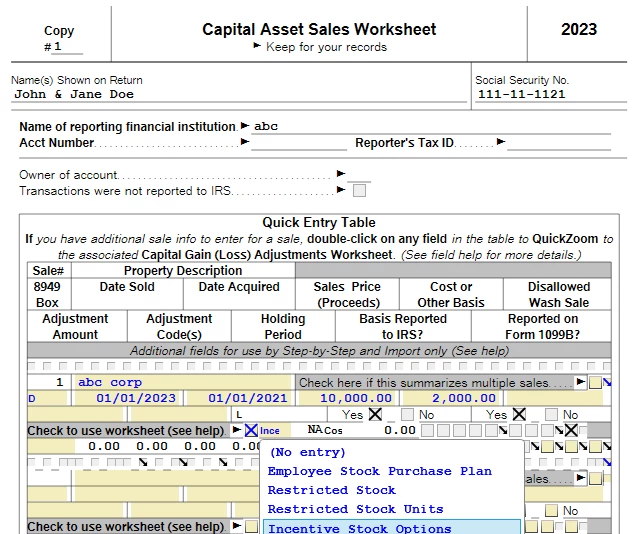


    Double clicking (on PC don't know about Mac) on any of the fields there  (or selecting the field and clicking the magnifying glass) got me to the Capital Gain (Loss) Adjustments Worksheet. Part II has a checkbox and link to the Employee Stock option Worksheet. 
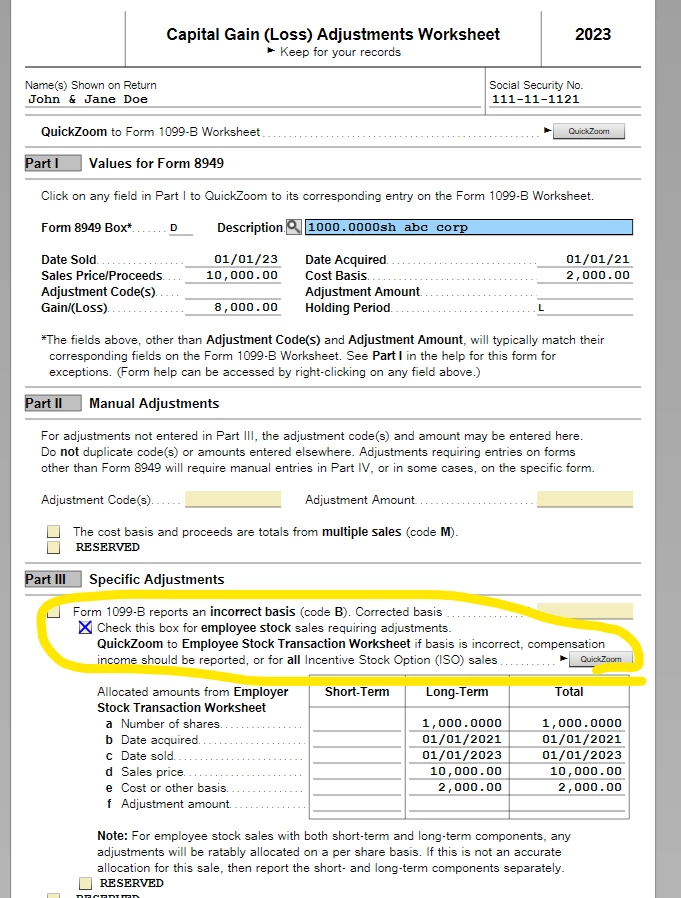


    That worksheet then lets you check Part II, line 10b (stock option) and in Part IV you enter the grant/exercise/sale info. It will then flow the different AMT gain to the Schedule D AMT and the 6251.


    However, in my test file I am seeing the AMT capital loss limited to $3k per year. And I have not figured out how to get the AMT credit form 8801 to work. That will be critical to getting you any credit. Sorry to say you might not actually get any credit if your AMT loss is limited to $3k and your AMT is not a lot less than your regular tax. But I have not figured out the 8801, so I just don't now.


    I hope that helps a little bit more. This is so very complicated and I haven't dealt with it in quite a few years.

    1 reply

    Employee
    March 20, 2024

    First this is super complicated. You might well want to ask a professional CPA, enrolled agent, or tax attorney for advice. One who deals with incentive equity everyday not just does 1040s. 


    For good background this is the goto book on all things equity option related: 


    https://amzn.to/3IJKCDF


    Their website is also excellent: 


    https://fairmark.com/compensation-stock-options/incentive-stock-options/exercising-isos/


    So what happens is that you have to think of the AMT as a totally separate tax system. You compute your regular taxes. Then you compute your AMT. You pay the higher of the two taxes. Under some circumstances you can get a credit to offset your regular taxes if your regular tax is higher than your AMT. See below.


    For ISO sales you have a different regular tax and AMT basis for the shares. (Gain/loss on sale of a capital asset is sales proceeds minus basis. Basis is usually the cost of acquisition.)


    Using your numbers  for your ISO shares your regular tax basis is $2k. Your AMT basis is $40k. 


    If you sell for all shares for $10k, you have a a regular tax capital gain of $8k and an AMT capital loss of $30k.


    When entering sale you also need to enter an "AMT adjustment" accounting for the different basis. (Here an adjustment of $38k because to get your 2023 AMT gain you take your regular gain of $8k and subtract $38k to get a AMT capital loss of $30k.).


    You enter that here (or in forms mode enter the form "Schedule D AMT: Capital Gains & Losses AMT")


    You cannot go back to 2021 and change anything. It appears that you handled the year of exercise correctly. The issue is whether or not you can get an AMT credit to offset your regular tax in the year of sale (or thereafter).  That seems to happen if your regular tax is greater than your AMT and you had prior AMT because of timing issues. It appears to be limited to your current year regular tax - your current year AMT. I'm not sure of the details (haven't dealt with ISOs in a decade) anymore. Take a look at 


    https://www.irs.gov/forms-pubs/about-form-8801


    In particular the 8801 (and TT interview) require numbers from your prior year 6251 (AMT). Do you have that? Or just a 6251 for 2021? So I'm not sure how that works if you don't have it for the prior year. I'd suggest you carefully review the 8801 instructions and/or seek professional advice.


    You get to the AMT credit section of TT here:


    Some other interesting discussion:


    https://www.esofund.com/blog/amt-credit-iso


    https://www.bogleheads.org/forum/viewtopic.php?t=398288


    **Say "Thanks" by clicking the thumb icon in a post**Mark the post that answers your question by clicking on "Mark as Best Answer"
    March 20, 2024

    Thanks for the thorough explanation! I'll go through the references you listed and review the TT interview to see if I can get some credit.


    I do have 6251 for both 2021 and 2022. However, it seems TT only looks back at 2022, but the exercise traction happened in 2021. That's why I wondered if TT can look back at 2021's 6251 and automatically credits back the AMT. I didn't mean to adjust the 2021 tax return.




