
Employee
March 13, 2023
Solved

Prevent Turbotax from deducting Capital Loss

  • March 13, 2023
  • 1 reply
  • 0 views

Hi,

According to this article https://turbotax.intuit.com/tax-tips/investments-and-taxes/capital-gains-and-losses/L7GF1ouP8

  • If you have an overall net capital loss for the year, you can deduct up to $3,000 of that loss against other kinds of income, including your salary and interest income.

Notice that it says "can", not "must".  So per my understanding I can choose to deduct less than 3000 (or even 0) if I wanted to. This is exactly what I would like to do and carryover all my losses to the next year.


TT applied deduction automatically (even though it wasn't needed as my ordinary income tax would be 0 anyway) and didn't let me chose whether I want it or not.


The question is: How do I instruct TurboTax not to deduct the Capital loss against other type of income?


It looks like a serious limitation which would cost people $3000 unless there is a way to fix it.
 

Best answer by john.inbox

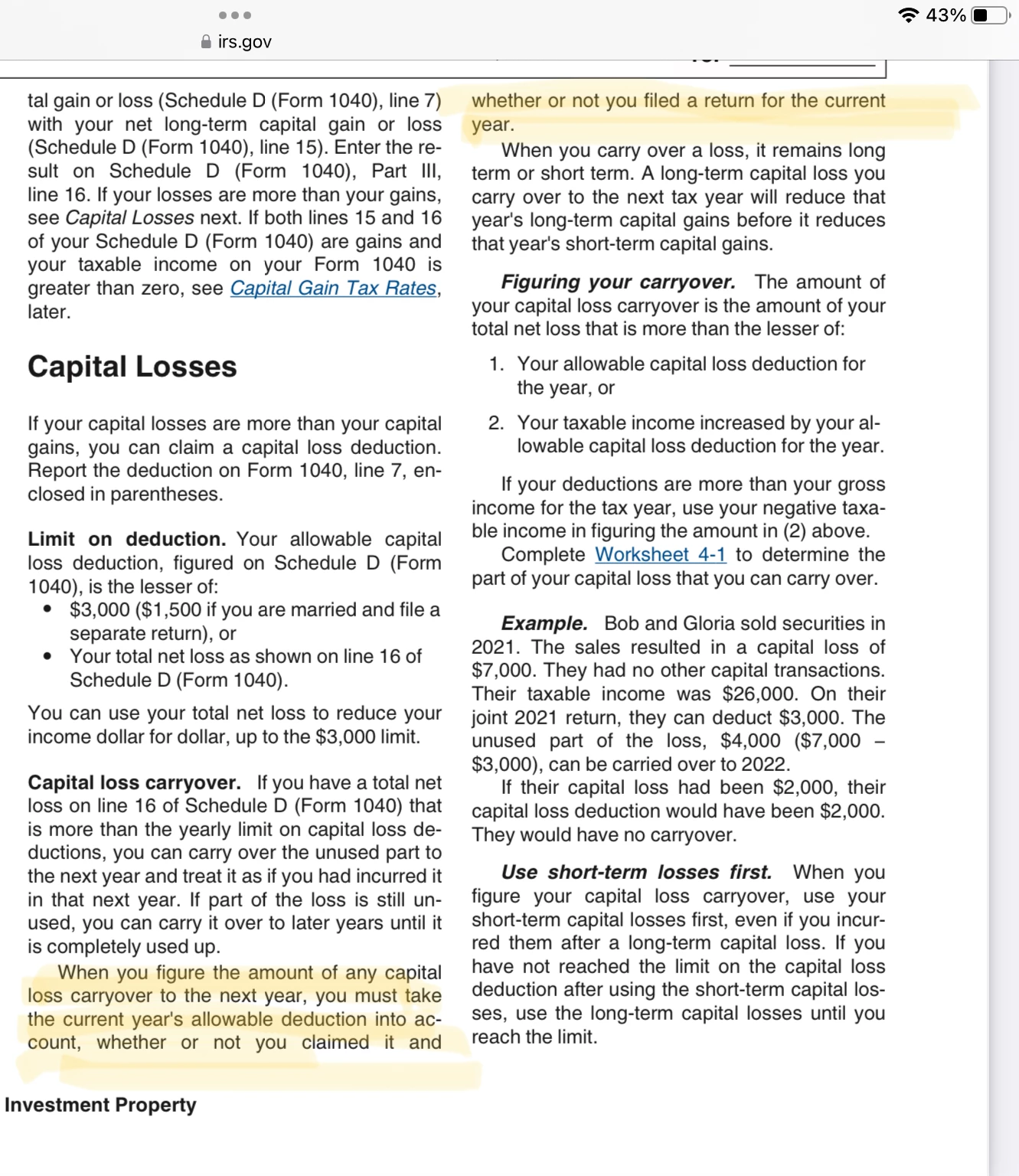
This from IRS pub 550


Ok. So here is the detailed and correct answer which I was able to figure out myself by looking at the formulas in the  Capital Loss Carryforward Worksheet. It's more complex than I initially thought. Hopefully it can help other people in the same situation.


If your taxable income (1040 ln 15) is 0 or more then Capital Loss Carryover will be reduced  by 3,000 (1,500 MFS) as VolvoGirl correctly pointed out.


If your taxable income is negative (note: Ln 15 will still show 0 but the actual calculation will give you negative number)  then Capital Loss Carryover will be reduced  by [3,000 (1,500 MFS) + taxable_income].


For example:

if your taxable income = -2000, then Carryover is reduced by [3000+ -2000]=1000

if your taxable income = -3000 (or -4000, or even less) than Carryover will not be reduced at all and you will get the whole amount of Capital Loss carried over to the next year. (which is what I was hoping for in my case, but unfortunately my taxable income is not negative.)


And TT does handle it correctly for the above examples.

1 reply

VolvoGirl
Employee
March 13, 2023

If you have a net loss for the year you can only deduct 3,000 (1,500 MFS) max on your tax return.  The rest you have to carryover to next year.  You have to report the carryover every year until it's used up.  You can't skip a year.  


See Publication 550.  Capital Losses start on page 66

https://www.irs.gov/pub/irs-pdf/p550.pdf


But If you have a negative AGI or negative taxable income it will show up on 1040  BUT it won't reduce the carryover to the next year.


On the income page The 2022 column shows the carryover to 2023 (not your current loss for 2022).  Schedule D doesn't actually show the carryover amount. To find your  Capital Loss Carryover amount  you need to look at your  return schedule D page 2.  Line 16 will be your total loss and line 21 should be a max loss of 3,000.  The difference between line 16 and 21 is the carryover loss for next year.


There is also a Carryover Worksheet showing the carryover from the prior year and the current amounts.  Then there is also the Capital Loss Carry Forward worksheet showing the amount transferring over to next year.


In the Online version you have to save your return with all the worksheet as a pdf file to your computer to see the Capital Loss Carry Over and Carry Forward worksheets.


In the Desktop program you can go to Forms and find it in the list in the left column.

Employee
March 13, 2023

Sorry, it looks to me that you didn't understand my question or maybe I didn't explain it well.

Let me try to describe it with an example:

I have:

- low AGI and all taxes would be discounted by the tax credits.

- Capital loss of $5000 from the stock trades

- I don't want to use the $3000 from my Capital Loss against my ordinary income (there is simply no need)

- I do want to carry forward the whole $5000 to the next year


According to the article I quoted it is possible, but TT automatically deducted $3000 and carried forward only $2000.


PS. I did look at the publication you are referring to and the worksheets prior to posting my question.

VolvoGirl
Employee
March 13, 2023

Yes I understand.  But the IRS says......

You have to report the carryover every year until it's used up.  You can't skip a year.  Even if you don't report it on your return you have to reduce it by the 3,000 (1,500 MFS) when you carry it over to next year.  You can't choose when to use it.


This is from the IRS Pub 550 page 66 Capital Loss Carryover

"When you figure the amount of any capital loss carryover to the next year, you must take the current year's allowable deduction into account, whether or not you claimed it and whether or not you filed a return for the current year. "


Here is pub 550…  http://www.irs.gov/pub/irs-pdf/p550.pdf




