
October 9, 2019
Question

Which rental expenses are pro-rated?

  • October 9, 2019
  • 1 reply
  • 0 views

I converted my primary residence to a rental property in the middle of 2018.  I have my all of my receipts for expenses.  When I enter them into TurboTax, it is doing some pro-ration based on the date I put the rental in service that is not matching up with my hand calculations.  I cannot see the math that TurboTax is doing so it is hard to understand the error.


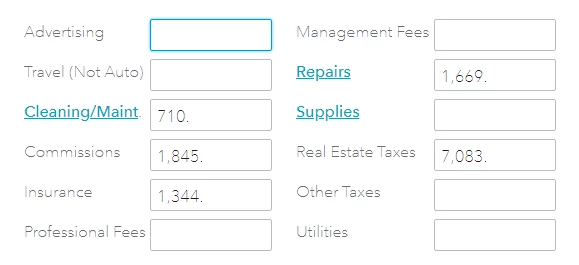
Of the following fields, which ones will TurboTax pro-rate based on the date I put it in service?  Which ones are includes as expenses at 100%?


Thanks,
Sal


1 reply

Carl11_2
Employee
October 9, 2019

For  the expenses section you will enter the "TOTAL" of what you paid *after* you converted it to a rental. There is only one exception. That exception is your property insurance costs. If you paid the insurance at any time in the tax year, then you will pro-rate the insurance based on "months in service" as a rental. It flat out does not matter when the insurance policy starts or ends. If you paid for a full year of insurance in the tax year, then you will pro-rate based on the number of months it was a rental in that full 12 month tax year.

So if you converted on July 1st to rental, and you paid $1,200 for 12 moths of insurance, you will enter $600 for the insurance costs since it was classified as a rental for only 6 months of the year.

You will "NOT" pro-rate anything else. That includes the mortgage interest. You enter the "TOTAL" mortgage interest paid, as shown on the 1098 - Mortgage Interest Statement you received from  your mortgage lender. The program will automatically do the split between the SCH E for the period of time it was a rental, and the SCH A for the period of time it was not a rental.

Below is some additional information you'll find helpful, because I know you will have more questions as you work it through the program. The below information should answer a vast majority (if not all) of those questions for you.

  • Rental Property Dates & Numbers That Matter.

Date of Conversion - If this was your primary residence before, then this date is the day AFTER  you moved out.
In Service Date - This is the date a renter "could" have moved in. Usually, this date is the day you put the FOR RENT sign in the front yard.
Number of days Rented - the day count for this starts from the first day a renter "could" have moved in. That should be your "in service" date if you were asked for that. Vacant periods between renters count also PROVIDED you did not live in the house for one single day during said period of vacancy.
Days of Personal Use - This number will be a big fat ZERO. Read the screen. It's asking for the number of days you lived in the property AFTER you converted it to a rental. I seriously doubt (though it is possible) that you lived in the house (or space, if renting a part of your home) as your primary residence or 2nd home, after you converted it to a rental.
Business Use Percentage. 100%. I'll put that in words so there's no doubt I didn't make a typo here. One Hundred Percent. After you converted this property or space to rental use, it was one hundred percent business use. What you used it for prior to the date of conversion doesn't count.

  • RENTAL PROPERTY ASSETS, MAINTENANCE/CLEANING/REPAIRS DEFINED

Property Improvement.

Property improvements are expenses you incur that add value to the property. Expenses for this are entered in the Assets/Depreciation section and depreciated over time. Property improvements can be done at any time after your initial purchase of the property. It does not matter if it was your residence or a rental at the time of the improvement. It still adds value to the property.

To be classified as a property improvement, two criteria must be met:

1) The improvement must become "a material part of" the property. For example, remodeling the bathroom, new cabinets or appliances in the kitchen. New carpet. Replacing that old Central Air unit.

2) The improvement must add "real" value to the property. In other words, when  the property is appraised by a qualified, certified, licensed property appraiser, he will appraise it at a higher value, than he would have without the improvements.

Cleaning & Maintenance

Those expenses incurred to maintain the rental property and it's assets in the useable condition the property and/or asset was designed and intended for. Routine cleaning and maintenance expenses are only deductible if they are incurred while the property is classified as a rental. Cleaning and maintenance expenses incurred in the process of preparing the property for rent are not deductible.

Repair

Those expenses incurred to return the property or it's assets to the same useable condition they were in, prior to the event that caused the property or asset to be unusable. Repair expenses incurred are only deductible if incurred while the property is classified as a rental. Repair costs incurred in the process of preparing the property for rent are not deductible.

Additional clarifications: Painting a room does not qualify as a property improvement. While the paint does become “a material part of” the property, from the perspective of a property appraiser, it doesn’t add “real value” to the property.

However, when you do something like convert the garage into a 3rd bedroom for example, making a  2 bedroom house into a 3 bedroom house adds “real value”. Of course, when you convert the garage to a bedroom, you’re going to paint it. But you will include the cost of painting as a part of the property improvement – not an expense separate from it.




